Artificial intelligence is transforming the economy. That doesn’t mean every company tied to it will deliver on expectations—or that households know how much their savings depend on its success.
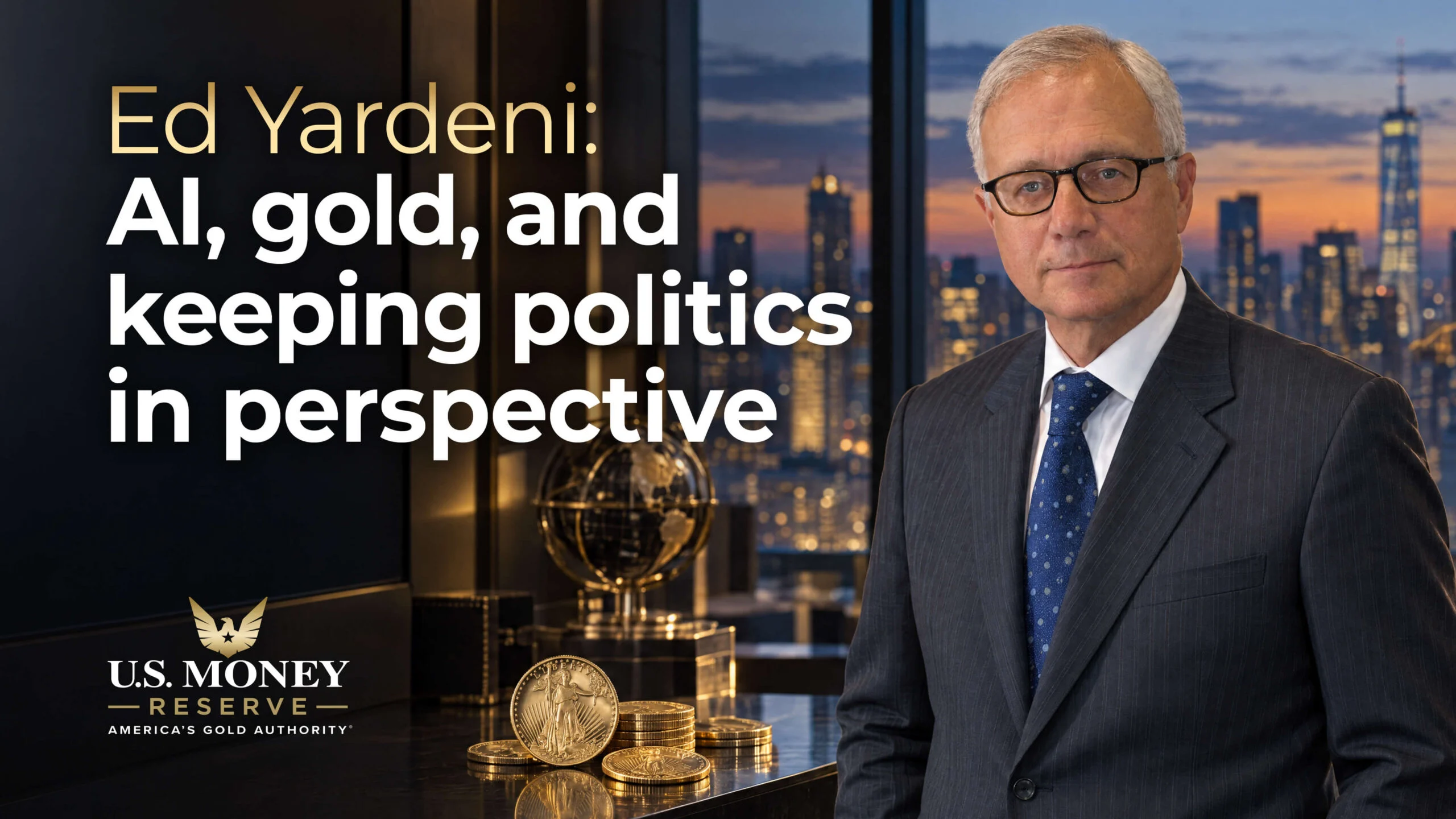
“The economy has become rather dependent on this AI boom,” says economist Dr. Ed Yardeni. Discussing the technology giants’ spending on AI infrastructure, he adds, “They’re spending money so much faster than they’re making it—that’s getting people very, very nervous.”
In the second half of his conversation on America’s Gold Authority®, Yardeni joins Philip N. Diehl, the 35th Director of the U.S. Mint and President of U.S. Money Reserve, to examine AI’s promise, the risks surrounding it, and the role gold can play alongside other assets. Their discussion also explores government debt and a question that can shape financial decisions: How much attention should Americans give Washington?
Yardeni’s perspective combines optimism about technology with an acknowledgment that preparing for less favorable outcomes still matters.
Watch the Podcast An Uncertain Future: A Conversation with Ed YardeniAI’s promise comes with financial questions
AI is already generating revenue, but the scale of spending on its infrastructure raises questions about when the returns will justify the expense.
The stakes extend beyond the companies building the technology to households whose retirement savings include AI-related stocks.
“A lot of households have money in the stock market, and the stock market clearly has been led by AI-related stocks,” Yardeni says. “If it’s a speculative bubble and it bursts, previous speculative bubbles have taken the economy down.”
That risk doesn’t diminish his confidence in AI’s long-term potential; Yardeni believes the technology is here to stay. But success depends on whether AI delivers meaningful improvements for the people and businesses using it.
Diehl shares that enthusiasm while questioning how American developers will fare against lower-cost competitors.
“I use AI and I am knocked out,” he says. “I’m afraid the Chinese are going to eat our lunch with these open-weight models.”
Related Article Beyond the AI boom: What the outlook through 2030 could mean for goldWhy Yardeni’s outlook includes gold
Gold has a role in a portfolio even when stocks are rising, Yardeni says.
“My bullishness on gold is based on the rebalancing idea,” Yardeni says. “Stocks go up, people rebalance and buy more gold as a result. Central bank purchases provide another source of demand.”
That perspective gives gold a role even within an optimistic outlook for stocks. In Yardeni’s view, rising stock prices can prompt buyers to spread their gains across other assets.
Many institutions, including Morgan Stanley and Goldman Sachs, now recommend a 60/20/20 asset mix in (60% stocks, 20% bonds, and 20% gold) as a starting point for portfolio discussions.
Related Article Why do China and other central banks keep buying gold?A flight to safety can take more than one form
Diehl also questions whether falling U.S. bond yields reflect a flight to safety amid international tensions and economic strain.
Yardeni explains that several forces can move bond markets at once, from growth expectations and inflation to debt concerns and geopolitical developments. He also describes a scenario in which gold and the U.S. dollar strengthen together.
“In a geopolitically volatile world, we could have a situation where gold does well and the dollar does well, and bond yields fall in the U.S. because of that flight to safety,” he says.
His outlook leaves room for uncertainty: “I don’t know that the geopolitical situation is going to get any calmer. [It] could get worse.”
The challenge lies, in part, in relying on a single forecast. Different assets can respond to the same event in different ways, and the relationships between them can change with the circumstances.
Government debt remains a concern
Yardeni’s optimism about technology doesn’t erase his concerns about federal finances.
“We really are on an unsustainable fiscal path,” he says. He argues that bond markets can pressure governments to respond when debt concerns intensify. But that creates another question: Will political leaders be able to agree on a response when one is needed?
Diehl is skeptical about the near-term prospects for agreement. “It’s hard to imagine we’ll be able to get that done in the next two years, but who knows?” he says. “We’re going through a period of turmoil and transition.”
Although the two approach some risks differently, Yardeni acknowledges the case for preparing for outcomes less favorable than his own forecast.
“I don’t have a problem with hedging against that possibility,” he says.
Keep politics in perspective
Near the end of the conversation, Yardeni offers a lesson drawn from almost five decades of following markets.
“It’s amazing how well the U.S. economy and stock markets do despite Washington,” he says. His advice? “Don’t let politics get in the way of making money.”
For households reviewing their savings, the conversation offers several questions to consider: What do your funds actually hold? How concentrated are those holdings? And does your mix of assets account for outcomes beyond the one you expect?
Related Article Gold after the midterms: Philip Diehl and Ed Moy on what comes nextExplore gold’s role in your retirement strategy
Your U.S. Money Reserve representative can explain your options for owning physical gold, including through a gold IRA, and answer questions about how precious metals may help protect and diversify your retirement savings.
Call a dedicated U.S. Money Reserve Account Executive at (866) 646-8465, and we’ll be happy to help.