In a special conversation on America’s Gold Authority®, the economist and market strategist explains why his bullish outlook for gold does not depend on a struggling stock market.
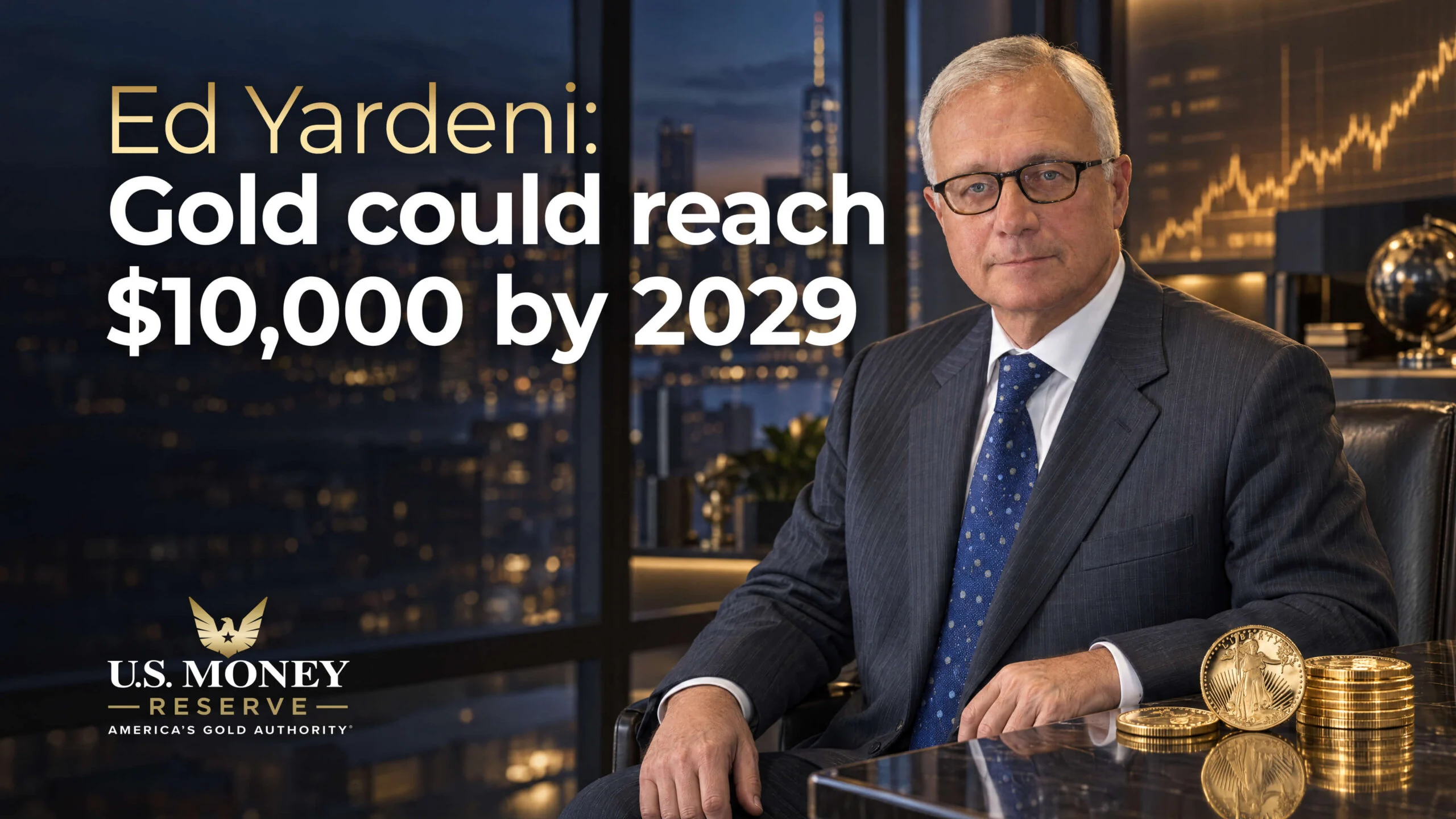
Gold could reach $10,000/oz. by the end of 2029, according to renowned economist Ed Yardeni. And in his view, that milestone could arrive alongside another: the S&P 500 reaching 10,000 index points.
Those are two different measures, but together they capture a distinctive outlook. Yardeni sees a path for gold to rise while the economy grows and corporate earnings support higher stock prices.
In a special episode of America’s Gold Authority Podcast, Yardeni joins Philip N. Diehl, 35th Director of the U.S. Mint and President of U.S. Money Reserve, to discuss the forces behind that outlook. Their conversation explores central bank gold demand, portfolio rebalancing, technological progress, and the risks that could challenge an otherwise optimistic economic scenario.
Watch the Podcast Gold at $10,000/oz.? A Conversation with Ed YardeniAn economist’s case for gold: the ‘Roaring 2020s’
Yardeni brings decades of experience studying the economy and financial markets. President of Yardeni Research, he previously held chief investment strategist roles at firms including Deutsche Bank and Prudential Equity Group, along with economist positions at the Federal Reserve Bank of New York and other federal institutions.
His outlook for the remainder of the decade centers on what he calls the “Roaring 2020s”—a scenario in which technological advances improve productivity, support economic growth, and help businesses increase earnings.
He sees automation, robotics, and artificial intelligence helping companies respond to a workforce affected by baby boomer retirements. Higher productivity, he explains, could support stronger profit margins and rising real wages while helping contain inflation.
That economic optimism also informs his stock market forecast. His S&P 500 target of 10,000 index points by the end of 2029 rests on anticipated corporate earnings and the multiple buyers would pay for them.
Yet his positive outlook for stocks leaves room for substantial gains in gold.
Why Yardeni sees a path to $10,000 gold
Yardeni identifies two potential sources of support for gold: central bank purchases and demand from people rebalancing their portfolios.
His central bank argument begins with the freezing of Russian assets following Russia’s invasion of Ukraine. In his assessment, that action gave some countries another reason to reconsider how much of their reserves they held in dollars and euros.
Gold, he argues, offers an alternative for central banks concerned about access to those assets during a confrontation with the United States or Europe. He sees that concern as a continuing motivation for purchases.
His second argument concerns what happens when stocks perform well.
As stock prices rise, equities can account for a larger share of a portfolio. Some owners may respond by moving a portion of those gains into other assets, including bonds and gold.
Under that scenario, a rising stock market could contribute to additional gold demand through rebalancing.
“If the S&P 500 gets to 10,000 by the end of the decade, by the end of 2029, gold could get to 10,000.”
Yardeni summarizes his outlook this way: “If the S&P 500 gets to 10,000 by the end of the decade, by the end of 2029, gold could get to 10,000.”
The significance lies in the reasoning: Gold’s potential role extends beyond responding to falling stock prices.
A correction within a longer-term bull market?
Yardeni also addresses gold’s pullback during the period discussed in the episode. He characterizes it as a correction within a bull market and maintains his longer-term bullish outlook.
But he acknowledges that gold does not always respond to events as people expect.
Geopolitical conflict, for example, can create competing pressures. Higher oil prices may strain the currencies of oil-importing countries, affecting their central banks’ ability to keep purchasing gold. Rising interest rates can also put pressure on gold prices.
These observations add context to the $10,000 forecast. Yardeni’s longer-term outlook allows for setbacks along the way, including periods when gold’s immediate response to uncertainty appears counterintuitive.
Related Article Is It Time to Buy the Dip in Gold?Where Yardeni and Diehl differ
The conversation also reveals differences in how the two assess bonds and government debt.
Diehl raises concerns about the difficulty governments face in managing their debt burdens. For people holding bonds, his concern is that inflation could erode the purchasing power of future interest and principal payments.
Yardeni acknowledges that risk but places greater weight on a more favorable outcome. He argues that bonds have become more attractive at the yields discussed in the episode and could benefit from the same portfolio rebalancing that supports gold demand.
Their exchange reinforces why diversification matters: Even experts can identify the same risks while reaching different conclusions about how those risks will unfold.
What the forecast means for the gold discussion
The $10,000 figure is the headline. The broader takeaway is Yardeni’s view that gold can have a place alongside stocks and bonds, even in an expanding economy.
His outlook brings together central bank demand, the effects of rising stock prices on portfolio allocations, and the possibility of continued economic growth. It also leaves room for uncertainty, corrections, and a less favorable economic outcome.
For Americans reviewing their savings, the episode offers a reason to consider how different assets may serve different purposes—and where physical gold might fit within that discussion.
Watch the full conversation with Dr. Ed Yardeni and Philip N. Diehl on America’s Gold Authority Podcast.
Questions? Don’t hesitate to contact a U.S. Money Reserve Account Executive. Call (866) 646-8465, and we’ll be happy to help.