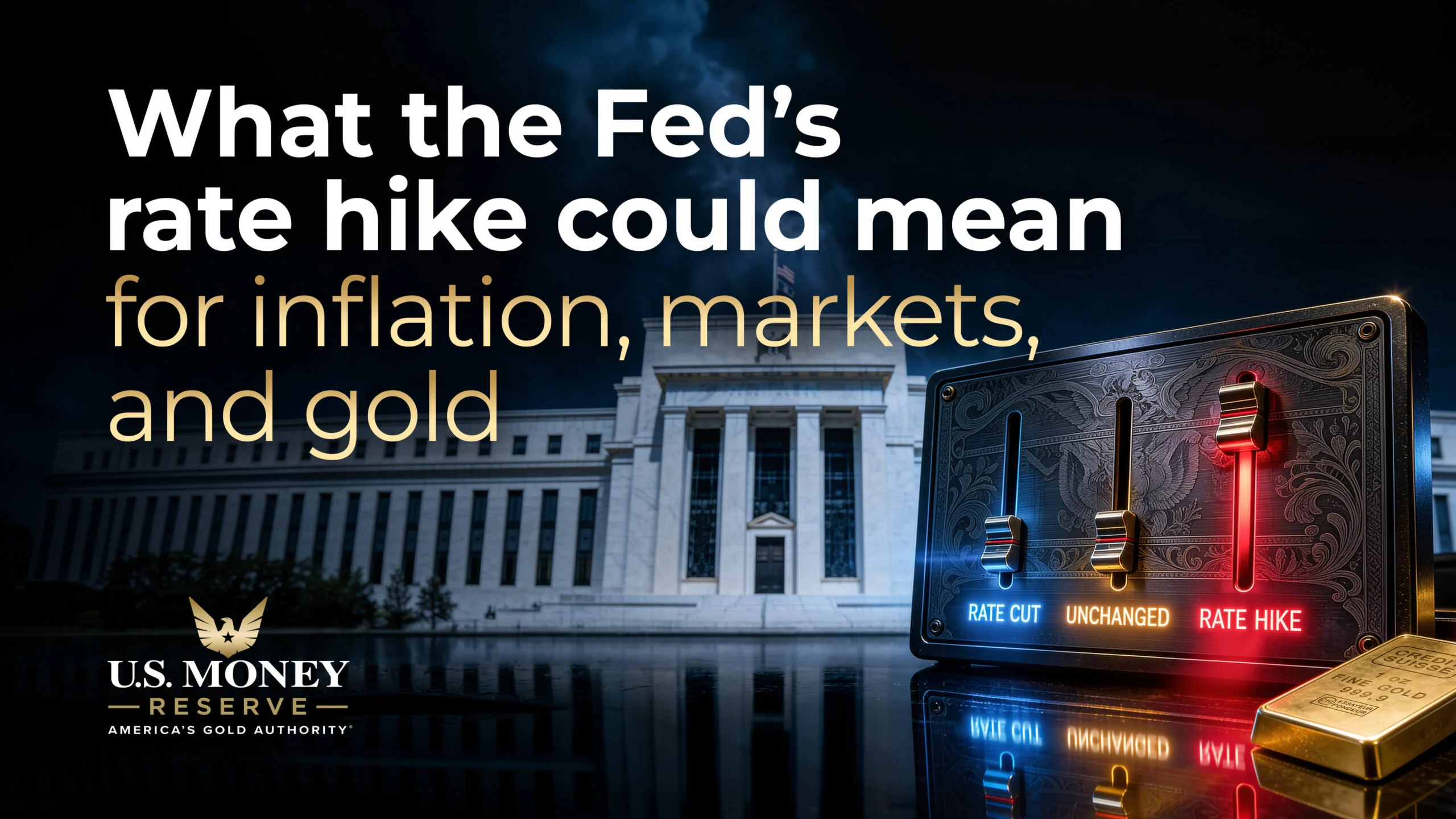
The Federal Reserve raised interest rates by a quarter of a percentage point on September 16, bringing the target range for the federal funds rate to 3.75%–4%.
The unanimous decision marked the central bank’s first rate increase since 2023 and a significant shift following three rate cuts in late 2025.
Federal Reserve Chair Kevin Warsh said the increase was intended to help return inflation to the Fed’s 2% target more quickly. New projections suggest the Fed may not be finished: Most officials expect at least one additional increase before the end of 2026.
The decision reflects the difficult position facing policymakers as persistent inflation, resilient economic growth, and pressure in the bond market complicate the path ahead.
Watch the Podcast Turning Rates Up: What the Fed’s Rate Decision Means for MarketsWhy the Fed raised interest rates
In its September policy statement, the Federal Open Market Committee (FOMC) said economic activity was expanding at a solid pace. Domestic spending remained resilient, productivity growth was strong, capital spending was robust, and unemployment had changed little.
Those conditions gave the Fed room to raise rates without responding to an immediate deterioration in the labor market.
Inflation, meanwhile, remains above the Fed’s target. Officials now project that personal consumption expenditures inflation will end 2026 at 3.7%, slightly higher than their 3.6% projection in June. Core inflation, which excludes food and energy, is projected to reach 3.4%.
“Today’s action starts to show we’re serious about this,” Warsh said following the decision.
Geopolitical conflict, higher energy costs, tariffs, and strong capital spending have all contributed to inflationary pressure, making it more difficult for the Fed to lower inflation without slowing economic activity.
Related Article The Fed is divided on inflation. Here’s why that matters for gold.Why inflation expectations matter
The current inflation rate is only part of the problem. But belief counts too—not just where inflation sits today, but where people expect it to go.
“What also matters is whether people and businesses believe the Fed can keep inflation relatively stable and predictable,” says Brad Chastain, Managing Director and Global Head of Research at U.S. Money Reserve. “If inflation consistently stays near an understood level, markets can adjust their expectations and plans accordingly. When inflation repeatedly exceeds the central bank’s target, however, that predictability begins to break down.”
Consumer inflation expectations moved sharply higher during the post-pandemic inflation surge and again around 2025’s “Liberation Day,” when President Trump announced a sweeping package of reciprocal import tariffs.
“That’s really called inflation expectations becoming unanchored, and that is a real warning sign,” says former U.S. Mint Director and U.S. Money Reserve President Philip N. Diehl.
When people expect prices to keep rising, those beliefs can influence wages, spending decisions, and business pricing. That can make inflation more difficult to control.
More rate increases may be ahead.
The Fed’s latest projections suggest that the September increase could be the beginning of a broader shift toward tighter monetary policy.
Of the 18 FOMC participants who submitted projections, 16 projected at least one additional quarter-point increase before the end of 2026. Twelve projected one more increase, four projected two more increases, and two projected no additional change.
The median projection places the federal funds rate at approximately 4.1% at the end of both 2026 and 2027. In June, officials projected rates of 3.8% and 3.6%, respectively.
Officials also raised their economic growth projections and lowered their projected unemployment rate. Stronger growth and a resilient labor market could give the Fed greater latitude to raise rates again if inflation remains elevated.
Why stronger growth may bring higher rates
The administration has discussed reducing the national debt relative to the size of the economy by generating growth that outpaces the accumulation of debt.
But sustained stronger growth does not generally point toward lower longer-term interest rates.
One way to understand the relationship is to compare nominal gross domestic product, or GDP, with the yield on the 10-year Treasury. Unlike real GDP, nominal GDP reflects both economic growth and rising prices.
Chastain notes that nominal GDP growth and longer-term interest rates have tended to move toward one another over time.
“If policies now produce persistently higher nominal growth, the same long-term relationship could pull rates higher,” he says.
Short-term movements can differ, but if faster nominal growth continues, higher longer-term rates may become increasingly difficult to avoid.
Related Article How gold price and interest rate trends are relatedThe decision reinforces the Fed’s independence.
The rate increase also carries political implications.
The administration has repeatedly called for lower rates. The Fed’s decision moved monetary policy in the opposite direction.
Warsh, who was appointed by President Trump and took office in May, joined all 11 other voting members of the Federal Open Market Committee in supporting the increase. The unanimous vote underscores the Fed’s independence and indicates that officials agreed inflation posed a greater immediate risk than a potential slowdown caused by higher rates.
What could the rate increase mean for gold?
The effect of higher interest rates on gold depends on more than the direction of rates. According to Chastain, it also depends on why rates are rising and what is happening to inflation-adjusted, or real, rates.
Higher nominal rates can create a headwind for gold when bond yields rise faster than inflation expectations. But if inflation expectations increase more quickly than nominal yields, real rates can decline.
“All else being equal, declining real rates can provide a tailwind for gold,” Chastain says.
The rate increase may reassure markets that the Fed is serious about inflation. But it also highlights the unusual combination of pressures confronting the economy: persistent inflation, heavy government borrowing, geopolitical uncertainty, higher energy costs, and political demands for lower rates.
Physical gold offers a tangible store of wealth outside the traditional financial system and can help diversify savings when the direction of inflation, interest rates, and monetary policy remains unclear.
Learn More Why buy goldWhat to watch next
The Fed’s next moves will depend on inflation, labor-market conditions, energy prices, and economic growth.
For now, policymakers appear prepared to keep rates elevated, and potentially raise them again, to bring inflation closer to their 2% target.
Whether the Fed can restore price stability without significantly slowing the economy will be the next—and more difficult—test.
Questions? Don’t hesitate to contact a U.S. Money Reserve Account Executive. Call (866) 646-8465, and we’ll be happy to help.