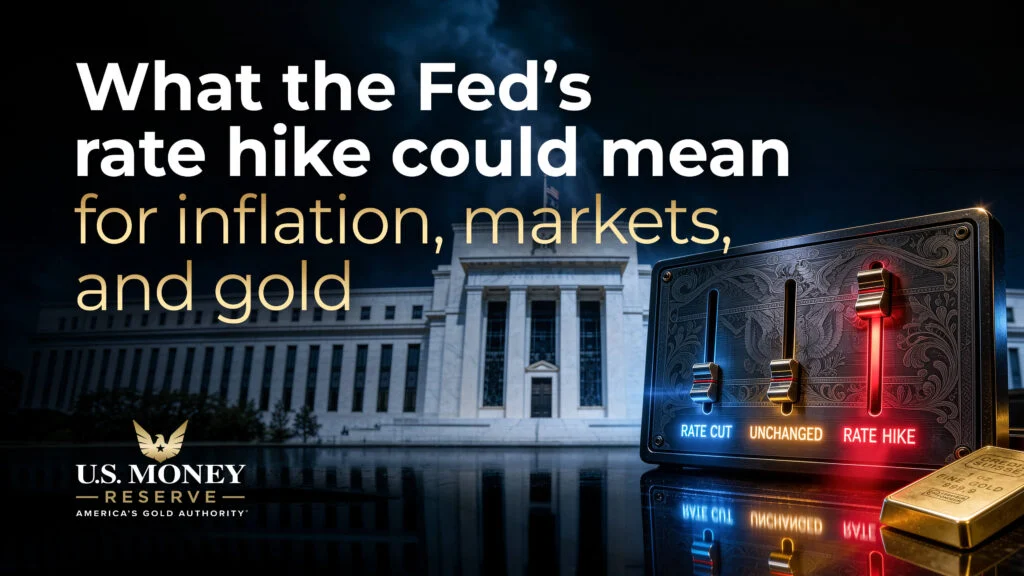

Gold and interest rates have often moved in opposite directions, but their relationship is more complicated than the familiar rule that “rates up” means “gold down.”
Inflation expectations, the strength of the U.S. dollar, central bank demand, fiscal concerns, and geopolitical uncertainty can all affect gold prices—and sometimes outweigh the influence of interest rates altogether.
Interest rates are only part of the picture.
Gold doesn’t pay interest, so holding it comes with an opportunity cost—the potential income you give up by not holding something that does pay interest, like savings accounts or bonds. When rates on those assets rise, that trade-off gets bigger, since you may be passing up more potential income. When rates fall, the trade-off shrinks, which can make gold more appealing as a store of wealth and portfolio diversifier.
Plus, the federal funds rate—the interest rate set by the Federal Reserve that influences mortgage and other rates set by private banks—does not directly impact the price of gold. Instead, a Federal Reserve decision can ripple through financial markets by affecting Treasury yields, inflation expectations, the U.S. dollar, economic growth, and market sentiment. Gold responds to that broader environment, not simply to the Fed’s announced rate.
Why do real interest rates matter to gold?
It is important to distinguish between nominal and real interest rates.
A nominal interest rate is the stated rate before inflation is taken into account. A real interest rate adjusts that return for expected inflation:
Real interest rate = nominal interest rate − expected inflation
Suppose a Treasury security yields 5%, while inflation is expected to average 2%. Its approximate real yield is 3%. But if inflation expectations also reach 5%, the real yield is effectively zero.
Higher real yields can make interest-bearing assets more attractive because they offer a return above expected inflation. Low or negative real yields can weaken that advantage, making gold comparatively more appealing.
What can happen to gold when interest rates rise?
Rising interest rates can put downward pressure on gold prices for several reasons:
- Higher real yields may make interest-bearing assets more attractive.
- Higher U.S. rates may strengthen the dollar. Since gold is priced in U.S. dollars globally, a stronger dollar makes gold more expensive for buyers using other currencies, which can dampen demand.
- Higher borrowing costs may slow economic growth and affect demand throughout financial markets.
But the reason rates are rising also matters. If the Fed is responding to elevated inflation, concerns about purchasing power may continue supporting demand for gold. Higher debt-servicing costs or fears of an economic downturn may also increase interest in tangible assets.
The Fed’s September 2026 rate increase offers a useful example. After the Fed raised its target range by 25 basis points, gold initially fell more than 1% as the dollar strengthened. The following day, gold recovered more than 2% as the dollar and Treasury yields retreated. The rate increase had not changed, but the surrounding market conditions had.
Related Article Turning Rates Up: What the Fed’s Rate Decision Means for MarketsWhat can happen to gold when interest rates fall?
Falling rates may reduce the opportunity cost of holding gold and make interest-bearing alternatives less attractive. Rate cuts can also weaken the dollar, making gold less expensive for overseas buyers.
But lower rates do not necessarily signal an improving economy. The Fed may cut rates because inflation is easing, or it may respond to weakening employment, slowing growth, financial stress, or recession risk. In those cases, gold may draw additional attention from people seeking greater diversification and protection from economic uncertainty.
Markets can also react before the Fed acts. Expectations about future rate decisions may be reflected in Treasury yields, the dollar, stocks, and gold well before an official announcement.
What else influences the price of gold?
Beyond interest rates, several forces may influence gold:
- Inflation expectations: Persistent inflation concerns may increase interest in tangible stores of wealth. Learn more in What happens when inflation expectations break loose?
- The U.S. dollar: A stronger dollar can make gold more expensive internationally, while a weaker dollar may support global demand.
- Central bank demand: Central bank purchases can provide a significant source of demand independent of U.S. monetary policy.
- Government debt: Rising debt and interest expenses may increase concerns about fiscal sustainability. Read A warning from the bond market: Trouble is building for the dollar and U.S. Treasuries.
- Economic and geopolitical uncertainty: Financial stress, economic downturns, wars, and trade disputes may increase demand for gold regardless of the direction of rates.
Gold as a long-term hold
Higher real interest rates have historically put downward pressure on gold prices, while lower real rates have often made the metal comparatively more attractive. But that relationship is not a rule.
Since 2022, central bank demand, geopolitical uncertainty, inflation concerns, and questions about government debt have helped support gold even during periods of elevated real yields.
Long-term gold buyers do not need to predict every Fed decision or short-term price move. Instead, they can consider gold’s broader role as a tangible store of wealth, a source of diversification, and a form of wealth insurance through a range of interest-rate environments.
Questions? Don’t hesitate to contact a U.S. Money Reserve Account Executive. Call (866) 646-8465, and we’ll be happy to help.