Transfer
Move funds directly from one IRA custodian to another without taking possession of the assets yourself. Transfers are one of the most common ways to fund a gold IRA.
Gold IRA
A gold IRA enables you to hold physical precious metals within a tax-advantaged retirement account. Discover how a gold IRA can help diversify your retirement savings and provide lasting protection.
Or call today
(866) 646-8465America’s choice
The #1 ranked precious metals dealer in the U.S.
Take your savings further
A gold IRA is a self-directed individual retirement account that allows you to hold physical gold and other IRS-approved precious metals as part of your retirement strategy. Like conventional IRAs, gold IRAs offer tax advantages. The key difference is the type of assets held within the account.

Americans are increasingly turning to gold IRAs to diversify beyond stocks and bonds and hedge against inflation.
Physical gold has a long history of performing differently than conventional financial assets during periods of economic uncertainty.
Flexible funding options
Most people don’t fund a gold IRA with new cash. Instead, they transfer or roll over retirement savings they’ve already accumulated. In many cases, that means moving $100,000 or more from an eligible retirement account.
Already have an IRA? Traditional, Roth, SEP, and SIMPLE IRAs can typically move into a gold IRA.
Funds from a 401(k) or 403(b) may be eligible—often once you’ve left the employer.
457 plans and the federal Thrift Savings Plan (TSP) may also qualify.
Certain pension plans and tax-sheltered annuities can be rolled over, depending on the plan’s rules.
3 ways to fund
Most gold IRAs are funded using existing retirement assets. Depending on your situation, you may be able to use existing retirement funds or make new cash contributions.
Move funds directly from one IRA custodian to another without taking possession of the assets yourself. Transfers are one of the most common ways to fund a gold IRA.
Move eligible assets from a former employer-sponsored retirement plan, such as a 401(k), into a gold IRA while maintaining the tax-advantaged status of your retirement savings.
Open a new gold IRA and fund it with annual contributions, subject to IRS contribution limits and eligibility requirements.
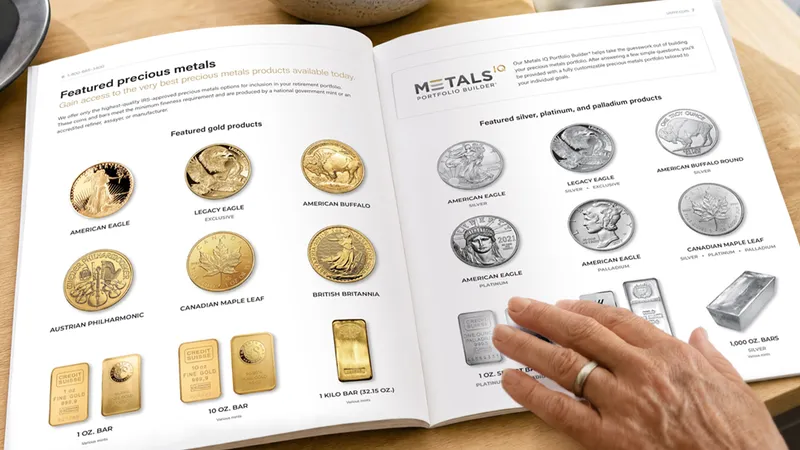
IRS-approved precious metals
Not all precious metals qualify for inclusion in a gold IRA. The IRS establishes specific purity requirements and eligibility standards. A gold IRA may hold certain gold, silver, platinum, and palladium products that meet those guidelines.


35 th Director of the U.S. Mint
President President, U.S. Money Reserve
38 th Director of the U.S. Mint
Senior IRA Strategist Senior IRA Strategist, U.S. Money Reserve
Top-ranked gold IRA provider
U.S. Money Reserve is the only precious metals company guided by two former Directors of the United States Mint. Their decades of leadership and industry expertise help shape our commitment to education, service, and the highest standards of professionalism.
Million
Clients served
Billion
In trusted transactions
Rating
From the Better Business Bureau
Years
Helping Americans diversify
Build a better future
Starting your gold IRA is simple, easy, and secure with U.S. Money Reserve. Transfer or roll over a portion of your existing IRA or qualifying retirement account today and enjoy these benefits:
We’ll help you complete your application and select precious metals, then ship them securely to your IRS-approved depository.
Once it’s time to take distributions from your account, you can liquidate your gold or take it home as an in-kind distribution without penalty.1
A gold IRA contains real, physical gold that you can later hold in your hands as in-kind distributions sent directly to your door.
Direct rollovers or transfers are generally nontaxable when moving funds from an eligible retirement account into a precious metals IRA.
We will cover your setup, transaction, transfer, maintenance, and storage fees for your first full year for accounts over $10,000.
From paperwork to portfolio design, we can handle all the heavy lifting to ensure a smooth, efficient, and stress-free experience.
Run the numbers
What would an earlier gold purchase be worth today? Enter an amount and select a year to compare gold’s performance with cash purchasing power.
2005
12.6×
your money
A whole house. In most of the country.
Appreciated value
$629,435
while those same dollars in cash would buy just $30,139 worth today
| Year | Gold price per ounce | Gold value | Cash purchasing power |
|---|---|---|---|
| 2005 | $444/oz. | $50,000 | $50,000 |
| 2006 | $604/oz. | $68,018 | $48,438 |
| 2007 | $695/oz. | $78,266 | $47,096 |
| 2008 | $872/oz. | $98,198 | $45,355 |
| 2009 | $972/oz. | $109,459 | $45,517 |
| 2010 | $1,225/oz. | $137,950 | $44,782 |
| 2011 | $1,572/oz. | $177,027 | $43,412 |
| 2012 | $1,669/oz. | $187,950 | $42,532 |
| 2013 | $1,411/oz. | $158,896 | $41,918 |
| 2014 | $1,266/oz. | $142,568 | $41,248 |
| 2015 | $1,160/oz. | $130,631 | $41,200 |
| 2016 | $1,251/oz. | $140,878 | $40,686 |
| 2017 | $1,257/oz. | $141,554 | $39,838 |
| 2018 | $1,269/oz. | $142,905 | $38,888 |
| 2019 | $1,393/oz. | $156,869 | $38,196 |
| 2020 | $1,770/oz. | $199,324 | $37,730 |
| 2021 | $1,799/oz. | $202,590 | $36,037 |
| 2022 | $1,800/oz. | $202,703 | $33,367 |
| 2023 | $1,941/oz. | $218,581 | $32,048 |
| 2024 | $2,386/oz. | $268,694 | $31,130 |
| 2025 | $3,432/oz. | $386,486 | $30,326 |
| January 2026 | $5,589/oz. | $629,435 | $30,139 |
The numbers tell a compelling story. Over time, gold has historically increased in price through changing economic conditions, rewarding those who held it for the long term rather than reacting to short-term market moves.
Meanwhile, inflation steadily reduces what your dollars can buy. Physical gold can help preserve purchasing power over time, giving retirement savers a tangible asset that isn’t tied to the performance of paper-based financial assets.
IRA buyback advantage
Gain added peace of mind with a first-of-its-kind protection available on certain qualifying gold purchases. Through our IRA Buyback Advantage program2, U.S. Money Reserve will buy back qualifying products at either their original purchase price or current fair market value—whichever is greater.

Limited time offer
For qualifying accounts purchases, U.S. Money Reserve will cover your annual storage and maintenance fees for life. It’s one more way we help make owning physical precious metals within a gold IRA more affordable over the long term.3
Account Setup Fee
Shipping & Insurance
Annual Storage Fee
Annual Maintenance Fee
Get started
Opening a gold IRA is simpler than you might expect. Our Account Executives guide clients through each step, from account setup through selecting eligible precious metals.
 STEP 1
Work with a gold IRA specialist to establish your self-directed IRA and complete the necessary paperwork.
 STEP 2
Transfer, roll over, or contribute eligible retirement assets to fund your account.
 STEP 3
Choose from a selection of IRS-approved precious metals that align with your goals and preferences.
Questions?
You’ve learned how gold IRAs work, how they’re funded, which assets they can hold, and why so many Americans include physical gold in their retirement strategy. Now it’s time to get answers specific to your situation.
Or call today
(866) 646-8465Common questions
When times look tough, many Americans don’t just worry—they act. They do as much research as they can, then put that research to work by making the most educated decisions possible for themselves, their families, and their financial futures.
March 2023 brought a string of banking headlines. Silicon Valley Bank (SVB) collapsed; UBS bought 166-year-old Swiss bank Credit Suisse in a deal backed by a $54 billion government lifeline; and 11 of First Republic Bank’s competitors injected $30 billion in uninsured deposits into the struggling bank.
Then, on March 19, 2023, several of the world’s central banks—including the Bank of Canada, the Bank of England, the Bank of Japan, the European Central Bank, the Swiss National Bank, and the Federal Reserve—announced “a coordinated action to enhance the provision of liquidity via the standing U.S. dollar liquidity swap line arrangements.”
When the world’s central banks work together to mitigate a banking crisis, it’s fair to say the banking industry is experiencing a high level of uncertainty. And with uncertainty can come volatility—leading many Americans to look for other options when it comes to protecting their savings.
Here at U.S. Money Reserve, our phones rang off the hook during that period with calls from clients concerned about the safety of their bank deposits. They were worried about whether their banks were also at risk and what that might mean for their retirement funds or the financial security of their loved ones.
If you find yourself worried about banking uncertainty or any resulting market volatility that may affect your retirement savings, it may be a good time to begin exploring the benefits of putting a portion of your retirement portfolio into physical gold—an asset many turn to in uncertain economic environments.
When you open a precious metals IRA backed by physical gold and silver, you create a new section of your portfolio that exists outside of the traditional banking system. Precious metals depositories must be approved by the IRS before holding the contents of an IRA, and they don’t function the same way as regular banks or credit unions.
With one of these accounts, you use actual gold bars and coins as part of your retirement savings, not gold mining stocks, gold ETFs, or other forms of “paper” gold. And when the time comes to take distributions in retirement, you have the option to receive those exact same gold coins and bars as an in-kind distribution.
Knowing that a portion of your savings is stored as real, tangible assets can help bring peace of mind in uncertain times—especially when planning for an uncertain future. If you think an IRA backed by physical gold could benefit your portfolio, give us a call today.
Gold and other precious metals IRAs are individual retirement accounts that hold physical metals. They work like a standard IRA but use precious metals instead of paper assets. Precious metals IRAs were first officially recognized by the Taxpayer Relief Act of 1997. These IRAs are self-directed, giving the owner more control over their portfolio.
The IRS permits select precious metals products in IRAs. The four precious metals permitted in an individual retirement account are gold, silver, platinum, and palladium, and gold is the most common. Many people use gold IRAs to diversify their portfolios and hedge against inflation, because gold has a historic tendency to rise in price when the dollar weakens. Gold is also a tangible asset, and millions of Americans have depended on gold and other precious metals to protect their savings throughout history.
When you open a gold or precious metals IRA, the funds you transfer, roll over, or deposit into your account are used to directly purchase physical gold, silver, platinum, and palladium products. Owning a gold IRA is not the same as owning gold ETFs or stock in a gold company. The assets in a gold IRA are tangible bars, coins, and bullion that you can arrange with your depository to inspect on-site and hold in your hands. And unlike with a gold ETF, there is zero leveraging—your funds are turned directly into the precious metals held in your IRA.
The assets that make up your gold IRA are kept securely in an IRS-approved depository. This isn’t a typical safe deposit box at your community bank—in many cases, these depositories specialize in precious metals storage and operate outside of the traditional banking system. And while traditional bank deposits are only insured up to $250,000 by the Federal Deposit Insurance Corporation (FDIC), and the FDIC doesn’t insure safe deposit box contents at all, precious metals depositories often insure deposits for far greater amounts, even up to 100% of the replacement cost of your stored precious metals.
In other words, your gold isn’t being used by a financial institution as part of a larger portfolio, isn’t affected by the systemic risks that may affect traditional financial institutions, and is likely insured for greater amounts than an ordinary bank account.
Gold IRAs stand apart from many other types of IRAs in that they are completely self-directed. While a custodian and a depository are required, all actions taken on your IRA are done at your instruction, and you are in total control of your asset mix. You are the sole owner of the precious metals in your IRA, and your custodian never makes decisions about your IRA without your consent. A self-directed IRA lets you take full control of your future and retirement strategy.
IRAs are often made up of a mixture of stocks, bonds, and other assets, usually compiled into packaged products by financial institutions. Because these portfolios are made up of paper-based assets like stocks, they are vulnerable to dramatic swings in the financial markets. Gold, on the other hand, has historically been seen as a hedge against market volatility, with gold prices moving independently of, or even inversely to, those of other, sometimes more volatile, assets like stocks. Placing a portion of your retirement portfolio into a gold IRA can help add an extra layer of protection to your retirement and act as wealth insurance against an uncertain future.
A gold IRA is set up as a self-directed IRA, a type of IRA that lets you purchase conventional assets as well as tangible assets like gold, real estate, and tax lien certificates. You can transfer or roll over funds from one of your retirement accounts to a gold IRA, or you can open a new self-directed IRA to house physical gold.
Whether you’re rolling funds over into an existing gold IRA or opening a new gold IRA, an IRS-approved custodian must purchase the gold. Because the custodian must be approved by the IRS, you can enjoy peace of mind about the proper handling of your gold transactions.
When you work through U.S. Money Reserve’s self-directed precious metals IRA program, your IRA Account Executive coordinates with your custodian to set up your IRA account and, if needed, arranges the transfer of funds from your old custodian to your new custodian.
IRA custodians are by no means “lone rangers.” They are required to follow certain IRS guidelines when holding assets belonging to their clients; those requirements govern everything from how checks are written to how transfers are wired. Custodians also face scrutiny by financial regulators.
So are gold IRAs safe from a setup perspective? Yes.
The IRS explains that an IRA is “for the exclusive benefit of you and your beneficiaries.” While an IRA account itself cannot be gifted, you can remove the assets from your IRA and then pass those assets on to other people as a gift. Here are three options for accomplishing that.
Say you would like to give some of your IRA funds as a gift during your lifetime. One way to potentially accomplish this would be to make a withdrawal and then pass the proceeds on to loved ones, like children or grandchildren.
However, such a gift is not tax-free. If money is withdrawn from a traditional IRA, income tax must be paid on the amount withdrawn, and if you as the IRA account holder have not reached age 59½, you will likely need to pay a 10% early withdrawal penalty on top of the income taxes.
Once taxes and penalties are paid, however, that money is yours to use or gift as you see fit. There are no constraints on the use of the money. It can be given to a family member, donated to a charity, or used to purchase other assets.
But if a gift of money from an IRA exceeds the annual gift tax exclusion, which the IRS adjusts each year, you may be required to file a gift tax return.
Consult with your financial institution or tax advisor before making any IRA withdrawals. Everyone’s situation is different, and there are some exceptions to the taxes on IRAs.
Naming a beneficiary (or beneficiaries) is part of setting up your IRA. Once you pass away, whoever you have named as your beneficiary inherits the IRA and all its contents. There is a tax benefit here as well, because an IRA in the name of a deceased person is not taxed when it’s inherited by that beneficiary. Once they inherit the IRA, the beneficiary must then completely cash out the entire IRA or transfer the funds to an annuity account.
This process is different for a spouse who’s designated as a beneficiary of an IRA. If you have your spouse listed as a beneficiary, they may treat the IRA account as though it had been theirs all along—they can withdraw money from the IRA account or leave the account untouched.
Another way to build generational wealth through an IRA is to contribute to an account in the name of a child or grandchild. This can be a great way to involve family members in your financial plans while having conversations that introduce them to the importance of financial planning and financial literacy.
Contributions are capped at the annual IRA contribution limit or the child’s earned income, whichever is lower. Contributions beyond that limit are taxed.
A child’s earned income could come from traditional work, such as walking dogs, babysitting, delivering papers, serving as a lifeguard, or working at a local fast-food restaurant. Money from an allowance or cash gifts does not count as income, explains Farm Bureau Financial Services.
If the child or grandchild is a minor, it’s recommended that the IRA be a custodial account overseen by a guardian (typically a parent or grandparent).
Contributions to a child’s or grandchild’s IRA count toward the annual gift tax exclusion for that recipient.
Gold IRA beneficiary rules are the federal regulations that govern who inherits a gold or precious metals IRA after the original account owner passes away and how quickly the inherited account must be distributed.
For tax purposes, a gold IRA is simply a self-directed IRA holding IRS-approved physical metals. According to the IRS, beneficiary rules apply uniformly across IRA types—traditional, Roth, SEP, SIMPLE, and self-directed precious metals IRAs—although the tax treatment of the distributions themselves differs based on whether the account was funded with pre-tax or after-tax dollars.
A few terms to know up front:
These terms matter because the rules a beneficiary must follow depend heavily on (1) who they are in relation to the deceased, (2) whether the deceased had reached their RBD before death, and (3) when the death occurred relative to the SECURE Act of 2019.
When the original owner of a precious metals IRA passes away, the account doesn’t simply transfer to a beneficiary like a checking account would. The custodian is notified (typically by the executor of the estate or a family member), the account is retitled as an inherited IRA in the beneficiary’s name with the original owner’s name retained on the title, and the beneficiary chooses among several distribution options based on their relationship to the deceased.
According to Empower, an inherited IRA is generally distinguished by titles like “Beneficiary IRA” or “Inherited IRA,” with the deceased owner’s name retained on the account title. Additional contributions cannot be made to an inherited IRA.
For a gold IRA, the physical metals remain in the IRS-approved depository during this transition. The depository simply updates its records to reflect the new account ownership. Beneficiaries who want to take physical possession of the metals can do so as part of a distribution, but doing so is a taxable event for traditional IRAs and follows the same withdrawal rules as a cash distribution.
For an inherited traditional gold IRA, yes—distributions are generally taxed as ordinary income in the year withdrawn. For an inherited Roth gold IRA, qualified distributions are generally tax-free if the original Roth was funded for at least five years before the original owner’s death. Tax treatment is nuanced and depends on the type of account and the timing of distributions, so checking the latest IRS guidance and/or consulting a tax professional is recommended.
The main difference between a gold and silver IRA is simply its contents—which precious metal you choose to hold in your IRA. That said, understanding the differences between gold and silver can help you make a more informed decision about what ratio (if any) you wish to have between different precious metals in your precious metals IRA.
Historically, silver has seen stronger short-term price rises than gold because of its larger potential industrial uses. As a malleable, strong, and electrically conductive metal, silver is used in consumer appliances, water purification, furniture, dentistry, LED chips, semiconductors, and more.
Gold, meanwhile, is rarer than silver, with 244,000 metric tons of gold discovered to date, compared with 1.74 million metric tons of silver. This relative scarcity can affect gold prices because of supply and demand.
A transfer of your IRA to gold via a self-directed IRA can make sense for several reasons. Here are four of them:
A traditional gold IRA follows the tax rules of a traditional IRA, while a gold Roth IRA follows the tax rules of a Roth IRA. The key difference is when you pay taxes:
Your ideal account type depends on factors like your current tax bracket, expected retirement income, and long-term financial goals.
Yes. Many people roll over funds from eligible retirement plans into precious metals IRAs. IRS guidelines must be followed to avoid penalties.
Most gold IRA providers break their pricing into several recognizable categories. Understanding each one is the foundation of an informed comparison.
The setup fee is a one-time charge that opens the account. It typically covers paperwork, IRS registration of the custodian-client relationship, and the administrative work involved in establishing a self-directed IRA.
According to industry surveys reported by CNBC Select, gold IRA setup fees commonly fall in the range of $50 to $150. Some providers waive the setup fee entirely for accounts that exceed a certain funding threshold, while others bundle it into a first-year promotional offer.
The custodian is the IRS-recognized entity legally responsible for holding the account. This is distinct from the dealer that sold you the metals and the depository that vaults them.
Annual custodian fees generally cover ongoing IRS reporting, recordkeeping, statements, and the administrative work that keeps the account in good standing. Industry reporting from Yahoo Finance and individual custodian schedules suggest that annual custodian fees commonly run between $75 and $300 per year, depending on the provider and whether the fee is flat or asset-based.
Because the IRS requires that IRA metals be stored at an approved depository, storage fees are unavoidable—but they vary meaningfully based on how the metals are stored and how the depository structures its pricing.
Reporting compiled by Yahoo Finance and individual depository schedules suggests gold IRA storage fees typically range from $100 to $300 per year for flat-fee accounts, or roughly 0.5–1% of account assets for accounts charged on a percentage basis.
Some custodians charge per-transaction fees when you buy, sell, or exchange metals inside the account. Others bundle these into the annual administration fee. Per-transaction charges on custodian fee schedules typically fall between $20 and $40, though some are higher for certain transaction types.
Wire transfer fees, often a flat $25 to $30 per outgoing wire, are a small but noteworthy line item if your account activity involves frequent funding or distributions.
A gold IRA rollover is the process of moving funds from a 401(k), 403(b), TSP, or another IRA into a precious metals IRA. There are two types of rollovers: direct and indirect. In a direct rollover, one custodian transfers funds directly to the other. In an indirect rollover, a check is sent to the owner of the account, who must then deposit those funds in the new account within a set timeframe.
According to the IRS in Topic no. 413, Rollovers from retirement plans, a properly executed rollover is not a taxable transaction. For indirect rollovers, the 10% additional tax on early distributions generally does not apply so long as funds are transferred within the required timeframe. Direct rollovers are also not subject to the tax, as they do not involve distributions.
The good news for savers exploring these options: The rollover process itself is often free. Most custodians do not charge an inbound transfer fee for a direct trustee-to-trustee rollover. Where rollover-related fees can appear is on the outgoing side—the institution releasing the funds may charge a closeout or wire fee. The IRS publishes the rules governing rollover timing and the 60-day window in Publication 590-A.
It’s worth asking both institutions directly about any fees before you initiate a rollover, since these details aren’t always disclosed up front.
A gold ETF is a paper-based financial product that tracks the price of gold. Shares are bought and sold through a brokerage account, much like stocks. While some ETFs are backed by physical gold, shareholders generally own shares of the fund—not specific gold coins or bars.
A gold IRA, by contrast, lets you own IRS-approved physical precious metals within a tax-advantaged retirement account. The metals are purchased on your behalf and securely stored in an IRS-approved depository until you become eligible to take distributions.
Questions?
(866) 646-8465