Episode 80
Turning Rates Up: What the Fed’s Rate Decision Means for Markets
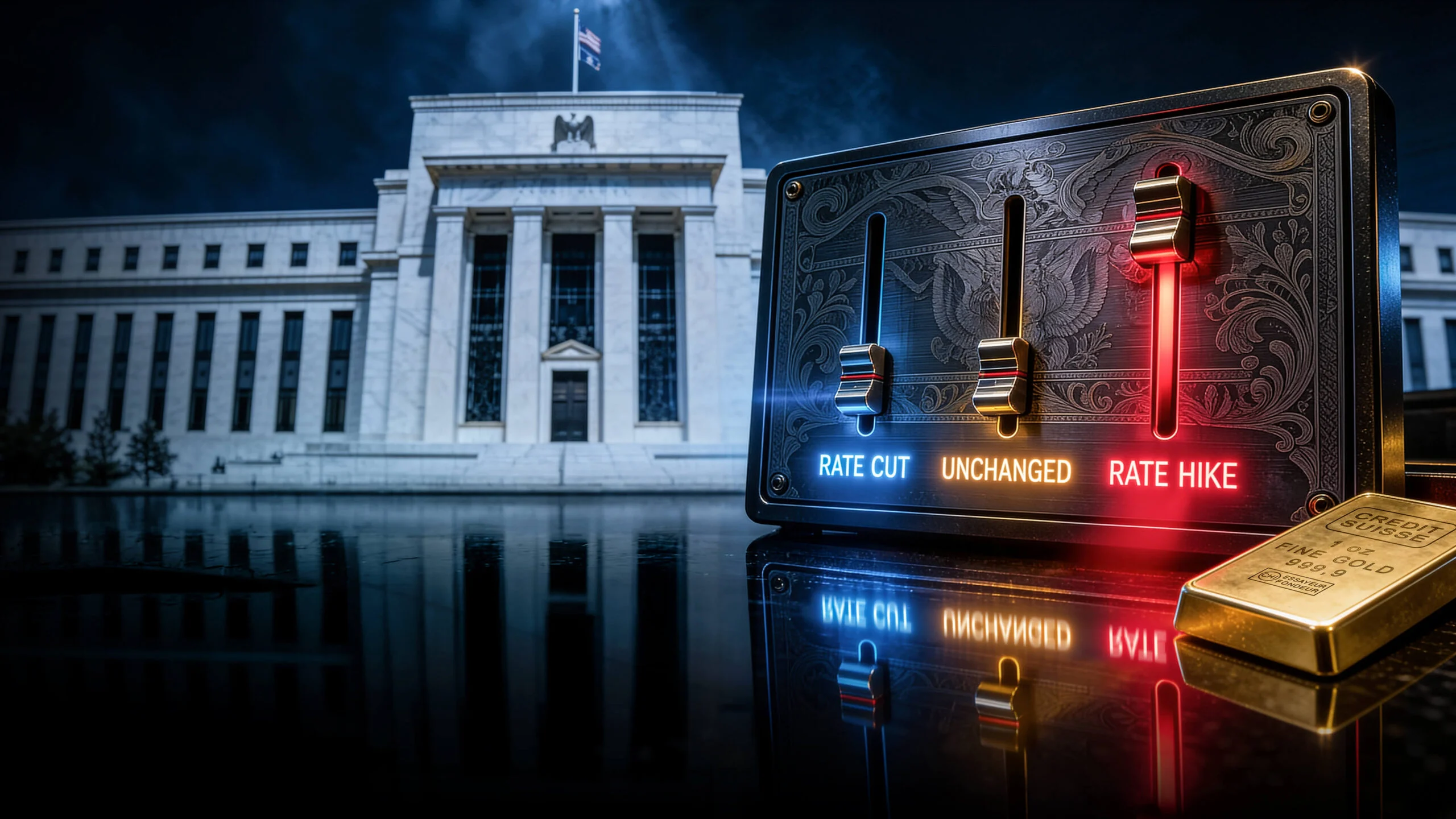
The Federal Reserve has raised interest rates for the first time in three years, marking a significant shift in monetary policy as inflation remains stubbornly elevated. The unanimous 25-basis-point increase may only be the beginning, with most Fed policymakers signaling that another increase could follow.
Key takeaways
- The rate hike itself matters less than the unanimity and the dot plot.
- Inflation is being driven by forces rate hikes can’t fully reach.
- Fighting inflation now is good for gold.
Episode notes
The Federal Reserve has raised interest rates for the first time in three years, marking a significant shift in monetary policy as inflation remains stubbornly elevated. The unanimous 25-basis-point increase may only be the beginning, with most Fed policymakers signaling that another increase could follow.
Philip N. Diehl, President of U.S. Money Reserve and former Director of the U.S. Mint, examines what drove the decision and why the Fed could face an even more difficult inflation fight in the months ahead. Rising oil prices, refinery constraints, geopolitical conflict, government spending, and mounting federal debt are all adding to the challenges confronting policymakers.
The discussion also looks back at the Fed’s aggressive response to inflation beginning in 2022, when a rapid series of rate increases helped push inflation lower. Diehl explains why controlling inflation expectations remains critical and why allowing higher prices to become entrenched could make the central bank’s job considerably more difficult.
Finally, the episode explores what the Fed’s new direction could mean for gold. While higher interest rates can create short-term pressure for the precious metal, Diehl argues that successfully bringing inflation under control could eventually open the door to lower rates—a shift that has historically influenced demand for gold.
U.S. Money Reserve is one of the country’s largest private dealers of government-minted gold, silver, platinum, and palladium. It’s the only precious metals firm guided by two former U.S. Mint Directors, giving the company unrivaled institutional insight. Having served more than one million customers and processed over $4.4 billion in transactions, U.S. Money Reserve is widely trusted for helping Americans safeguard their financial future.
Read the full transcript
MIKE BARNES 0:19
Welcome to America’s Gold Authority Podcast. My name is Mike Barnes. It’s the first rate hike in three years. 25 basis points, and Kevin Warsh has shown his hand. Looks like he’s all in. Let’s talk to Philip Diehl about that. Philip, the 35th Director of the United States Mint, President of U.S. Money Reserve. And I don’t think anyone at all was surprised by this rate hike, Philip.
PHILIP N. DIEHL 0:41
No, that’s right. They weren’t surprised. The the markets clearly expected a 25-point uh basis point increase. Um, however, they were surprised by a couple elements of it. One was the the vote, a 12-0 vote, a unanimous vote in favor of this. I I think uh the the most uh optimistic vote was probably a 9-3 vote, in which uh Kevin Walsh would have uh voted with the majority, uh, and then the three dissenters would been have been the other three uh Trump appointees, but they got a full unanimous vote on it. And I think that was very important. It’s gonna be interesting to see the minutes of this meeting, to see how they got to unanimity. It was important to send a message to the president and to markets that this was a united uh FOMC, and uh important to show that uh there was consensus about the need for a rate increase, and important to show that uh the Fed was ready to stand independent from the executive branch and from the inevitable pressure the president was going to put on the Federal Reserve, uh, not just for this decision, but for decisions to come. The second thing that was really uh sort of a surprise, and I think we saw this in the reaction of Wall Street after the decision, and that was uh 16 of the 18 dot plots, and the dot plots are an indication of where the members of the Federal Reserve uh board indicate where they think their decision is going to be uh headed in future uh decisions. And 16 of the 18 uh members uh indicated that they thought their next decision would be for another 25-point uh increase. And that was a surprise to the market, and the market responded negatively, and we’ll see where the market goes from here uh based on that expectation. That will also be interesting to look at the minutes to see uh where that played in the discussion, because my own personal feeling was that uh 25 basis points yesterday was week T was not enough to stem the tide of inflationary uh pressures today. Uh might have been helpful back in July, probably would have been helpful in July, but inflationary pressures had built in the subsequent two months. Uh also uh pressures have built in bond markets, and 25 basis points was insufficient now. But I think probably what happened, uh, there was discussion. Uh, I think I’m speculating here, of course. I didn’t have a microphone uh at the table, but my speculation is that there was uh considerable opinion uh around the table for 50 basis points, but they compromised on 25 basis points to gain unanimity. Uh, but uh we’ll see in the minutes uh to what extent that occurred. Uh, but clearly there was strong opinion close to consensus toward another 25 basis points. My own opinion also is that there is an underlying uh underlying uh readiness to go to a third 25 basis points or more come December. Uh, depending on what happens in oil markets, if the war drags on, even possibly gets worse with uh the oil crisis, prices continue above $100 a barrel, maybe even rise toward $130. We saw $130 a barrel uh in sub markets uh coming out of the Persian Gulf this week. Uh and uh and we have a problem with strategic uh petroleum reserve. We are below the minimum levels. We really are not in a position to tap it anymore. Uh other strategic petroleum reserves around the world are in a little better shape, but not much. This idea that we can tap the Venezuelan oil and refill the strategic petroleum reserve with Venezuelan oil is an absolute pipe dream. There is no way to do that for any number of reasons. I won’t get into here. It just cannot happen. And so we’ve really got our back against the wall. And I think things are going to get worse before they get better because the fall season is when uh refineries uh shut down for annual maintenance. There’s really no choice in this matter uh by the refineries. They have to do it, they cut over uh to winter blends, they’re in the process of doing that. We’ve been blessed by the fact that in uh an El Nino season, as we’re in, in fact, we’re in a Super El Nino, and as a result, we’ve had no uh Atlantic hurricanes enter the Gulf, and as a result, we haven’t had that kind of disruption of refineries. Uh, and so the problem really hasn’t been in the oil markets, hasn’t been crude oil production. We we uh are fine on crude oil production. The problem has been with refinery production, and that’s why uh diesel prices are so high, demand remains high and uh all over the world. And uh and so prices are very high, and that problem is really out of the Middle East. It’s with domestic, the problem lies here with domestic refineries. It is not just because of problems out of Russia and Ukraine, the Russians knocked out Ukrainian refinery production long ago. Yes, the Ukrainians are also knocking out Russian production, but uh uh you know, refinery uh production is tight all over the world. And refinery production and the constraints and the prices coming out of refinery production has an impact on inflation downstream all through the economy.
MIKE BARNES 7:58
Well, that comes to my next point that I know there are lots of topics, lots of factors that affect inflation, but it seems like the war is affecting it more than anything, and I don’t know if the basis points are going to affect it like the war does.
PHILIP N. DIEHL 8:11
Yes, no, that’s that’s exactly right. Um and the the 25-point basis, uh, the 25 basis point increase really is not going to have an impact at this at this point. The the bond markets, I think, are going to shrug it off. I think what is gonna be more meaningful is the indication that the Fed has taken seriously what uh the market has signaled to it here in the last several weeks that things have gone awry with the administration’s policy toward the bond market. Its intervention in the yen market, its attempt to control yield curves, um, and it’s it’s ineffective attempts. And really all attempts, even huge attempts, are ineffective. They might be effective in the very short term, but there’s a long history of ineffective attempts by administrations, not just this administration. And really, there’s no way to describe these these attempts other than really pathetic attempts. They’re jawboning and small incremental attempts and to no effective end. In fact, they’re counterproductive. And now what we have with this with this 25-point uh increase by the Fed is the beginning of a tug of war at counter-purposes between this administration and its own Federal Reserve. And that is not constructive to a unified uh administration policy, monetary and fiscal policy. And not only do we have a tug of war between the administration and the Federal Reserve’s monetary policy, but we have this huge contradiction between the administration’s fiscal policy and the Federal Reserve’s monetary policy. We have this hugely stimulative administration fiscal policy in which is spending money hand over fist on defense policy, in which it’s spending money on weapon systems and war without bothering to go to Congress to fund that war. And as a result, we have a we we have a government that is uh running up the debt at an extraordinary rates, over $40 trillion today, headed rapidly toward $41 trillion. And we have we have Social Security uh quickly approaching the edge of uh deficiency where we’ll have to within a matter of six years, it’s going to come faster than that. No doubt it’s gonna come faster than that. I think it’s gonna come within four years of uh being in a state where uh by law we’re gonna have to cut benefits across the board by 22 percent, unless we move rapidly to save it. And the administration has no plan whatsoever to address it, uh, except that I think its general plan is to cut it, to let the that deadline pass and to begin cutting in entitlements, because you can be assured this administration is not going to cut defense spending. It is running headlong to s to spend money on defense and national security issues.
MIKE BARNES 12:20
I’ve seen some critics are saying that the Fed is too data dependent, that they’re saying that these basis numbers are automatically going to affect inflation, which I guess normally that is the case, but not during wartime. So it’s hard to say exactly what’s going to happen at 25 basis points. But you have a graph that kind of shows how the rates and inflation go hand in hand in some ways.
PHILIP N. DIEHL 12:44
Yes. I want to I I want to walk people through uh this graph because the graph tells a really important story. It’s not too complex, but uh I I it orients us to events that are all familiar to us and help tell that story. So the red line here represents the uh the inflation rate. And the inflation rate is simply the CPI, the consumer price index that we all follow. And we start here at 2022 as the inflation rate reaches its peak at around 9%. And the Fed in the blue line here, we see the Fed begin a rapid rate of increasing its federal funds rate. And that’s a short-term rate that uh drives the rate that we all pay the banks for our loans, our car loans, our mortgage loans. And that rate is based typically on the 10-year Treasury bill. The Fed doesn’t set that rate, but it sets the federal funds rate. And the federal funds rate is marked here, and the rate at which that rate is uh is uh increased is shown here by this blue line. And you see how in a very short period of time the Fed is rapidly increasing that rate over the course of just over a year, almost to 6%. And over that period of time, uh it has a huge impact on the CPI. It drives the CPI, the inflation rate down very rapidly. So that’s an indication of how fast dramatic action and decisive action by the Federal Reserve can drive down inflation rate. That is a huge success story by the Federal Reserve. It acted a little late, and um, but when it did act, the Powell Federal Reserve successfully attacked inflation. And inflation continued to fall until right around late 2024, and it got down close to the Federal Reserve’s target of 2%. You see that in late 2024. Then what happened was in November 2024, we see the election occurred, and what happened then was at the time what was called the Trump trade effect occurred, which means markets, especially stock markets, immediately responded, like within a matter of a day or two, expecting very different policies under the Trump administration. And as a result, immediately the in uh inflation effect began to show up in the marketplace. And we see that in the in the uh CPI, and the CPI begins to increase. Another effect was the Fed became more optimistic that inflation was under control, and also it began to anticipate that the Trump administration was going to be more favorable toward lower interest rates, and it began to lower interest rates. And those two factors began to stimulate the economy and began to raise inflation. And inflation did rise, and then we saw see in April 2025 the Liberation Day, uh, where the tariffs were imposed. And those tariffs were much bigger than what were expected, and that uh increased inflation, and then we see the last big event, which was the Iran War began. Uh, and we come up here to uh the current date where the inflation is higher. Now we see that we now have had the most recent increase in in interest rates. So we see that some of the progress that has been made in fighting inflation has been given back up. We’re back up to inflation rates closing in on 4%.
MIKE BARNES 17:43
You mentioned so many factors that affect inflation. I don’t know how, unless you’re a soothsayer and Nostradamus able to see the future, how are you able to see what the expectations are? Because you don’t know what’s going to happen with the war, you don’t know what’s going to happen with the economy, you don’t know so many things, and yet the inflation expectations drive so much of what happens.
PHILIP N. DIEHL 18:05
Well, one of the members of the Federal Reserve Board, uh, John Williams, really said it best. And one of the crucial lessons, um, you know, most of us at my age, uh, and most of us who have studied uh or have uh or have an awareness of the threat that inflation poses to the economy and to our own economic well-being, know that the inflationary period from the 1970s tell a terrible story about uh how inflation erodes the confidence of the people and the and erodes the economic well-being of individuals in an economy. If you let inflation expectations get out of hand. And governments all over the world have learned that story. And that story is repeated over and over again through history, especially in third world countries and in Europe and in will and before World War II, between World War I and World War II. But uh John Williams, a member of the Federal Reserve Board, said it very well in a famous quote in which he said that’s one of the bedrock principles of central banking, is that uh consumer expectations is controlling consumer expectations is absolutely key to controlling info uh uh uh inflation.
MIKE BARNES 19:43
I thought it was very interesting on Wednesday when it was announced. Gold was actually up before the announcement, and then the announcement about the unanimous vote. Gold goes down, but it comes back up almost immediately. And it was up on Thursday last I checked. What’s going to happen with gold in the near future as we wait and see if there’s another 25 basis point rise?
PHILIP N. DIEHL 20:05
Well, I I’m sort of maybe I’m a contrarian on this. I have felt uh all along that an um an immediate attack on inflation is better for gold rather than just uh just you know dawdling and letting inflation uh get out of hand. Uh I think the the long-term prospects for gold are outstanding. Uh and letting inflation just get out of hand is delays the boom that is coming for gold. Uh, I think we need to attack if inflation, get it behind us, get the bad news of inflation behind us, and let uh the forces that are at work in the world that are going to cause the boom gold to come to the fore. And um, and once we get inflation behind us, then we’re gonna see interest rates fall, and that is gonna be one of the forces that drive gold up. And you know, this is not news. We have seen this play out for the last three years. This this has happened since early January or late 2023 and early 2024, when expectations have risen in the market that the Federal Reserve is going to low it lower interest rates, gold has taken off. And every time those expectations have been disappointed, gold has faded. And that’s where we are. Today. And so I think that um I think that’s what has happened here is that the Federal Reserve increased interest rates and the conventional wisdom sort of kicked in that oh, that’s bad for for gold. But then on second thought, uh the market realized that, oh no, finally the Federal Reserve is going to attack uh inflation, and that’s good for gold. And this this news that they’re gonna maybe they’re gonna get aggressive and really go after it. And and I suspect that we’re gonna see 25%, uh 25 basis points in October, and then maybe after the election, you know, get the election behind us and then really go after inflation, then that’s really gonna be good news for gold. Uh and and then uh then, you know, maybe then we’ll be able to see finally the shackles come off gold would begin to see that gold market take off. Um so uh I’m optimistic. Uh as long as we we see real courage from the Federal Reserve. Everybody thinks Jerome Powell is a is a is a dove on on interest rates. I I don’t know where this comes from. Jerome Powell was the driver on that chart that showed the aggressive attack on interest rates back in 2022. Drove Jerome Powell drove that. He had he led four 75 point uh interest rate hikes in four months, in four of them in four months to attack uh inflation. So no, he he is a dub when it’s an appropriate appropriate, and he’s a hawk when it’s appropriate. So I have no doubt that he was ready to go 25 basis points uh yesterday and uh and probably more. I don’t know that he would have spoken about he’s an institutionalist, and and he’s he would have followed the lead uh to the best of his ability uh of the new chair. Uh and he would he would be he would be sympathetic to the dilemma that the new chair was in. Uh, but he he’s also uh he’s a loyalist to the country and to the institution and and to into his profession and to his other members. He he’s he’s a real gentleman. Uh and and I was, you know, I have been a critic of the new chair. Uh I’ll just be frank. And I’ve been pretty frank before. Um but uh and really the secretary and the president did him a favor, and the markets did him a favor uh over the last week by making this an easy decision. The the Federal Reserve had no choice in the matter. They had to raise rates.
MIKE BARNES 25:23
Well, Philip Diehl, we love you being frank. We like you being a contrarian, we like you being optimistic, and we appreciate all that you had to say today. Thank you so much for joining us. You bet. My pleasure. Inflation is something the federal government can’t ignore. They have to attack it firsthand, and they are doing that right now, and we may see another attack with a higher basis point coming up in the near future. That’s all the time we have for today’s episode. On behalf of all of us here in the U.S. Money Reserve Studios, thank you so much for tuning in. If you have any questions or you want to learn more about today’s episode, you can call the number in our episode description and speak with one of our friendly account executives. They’re going to be more than happy to answer any questions you may have about precious metals and the strategic role they can play in achieving a secure and comfortable financial future. I’m Mike Barnes. We will see you next time on America’s Gold Authority Podcast.

Ready to protect your savings? Get your free guide today.
Get your free guideKeep listening
Related episodes
- Episode 78No Easy Choice: The Fed’s September Rate Decision
On this episode of America’s Gold Authority® Podcast, host Mike Barnes is joined by Philip N. Diehl, President of U.S. Money Reserve and former Director of the U.S. Mint, and Brad Chastain, U.S. Money Reserve’s Managing Director and Global Head of Research, to examine the Federal Reserve’s approaching September rate decision and whether Chairman Kevin Warsh will follow through on his tougher rhetoric regarding inflation.
Listen now - Episode 73A House Divided: The Fed’s Growing Internal Conflict
On this episode of America’s Gold Authority® Podcast, host Mike Barnes is joined by Philip N. Diehl, President of U.S. Money Reserve and former Director of the U.S. Mint, to discuss the Federal Reserve’s latest decision to leave interest rates unchanged and what growing disagreement within the central bank could signal for the economy.
Listen now - Episode 76Off the Chain: What Happens When Inflation Expectations Break Loose
On this episode of America’s Gold Authority® Podcast, host Mike Barnes is joined by Philip N. Diehl, President of U.S. Money Reserve and former Director of the U.S. Mint, and Brad Chastain, U.S. Money Reserve’s Managing Director and Global Head of Research, to examine why inflation expectations matter and what can happen when higher prices become entrenched in the economy.
Listen now