Artificial intelligence is reshaping markets. But the path from promising technology to profitable businesses is rarely easy, and the effects could reach well beyond technology stocks.
Philip N. Diehl, 35th Director of the U.S. Mint and President of U.S. Money Reserve, examines two possible paths for AI through 2030. One involves a difficult shakeout followed by a more profitable American AI industry. The other involves a deeper disruption as lower-cost competitors challenge U.S. companies.
For Americans considering their retirement savings, the question is how those scenarios could affect what they own—and whether their portfolios are prepared for more than one outcome.
Free Guide Explore the broader outlook in U.S. Money Reserve’s Global Gold ForecastTwo possible paths for AI
Diehl’s more optimistic scenario still involves substantial disruption. Some AI companies fail, others consolidate, and the strongest emerge with more sustainable business models.
He compares this process to earlier technological transformations, including the development of railroads, automobiles, and telecommunications. A technology can reshape everyday life even as some of the businesses developing it struggle or disappear.
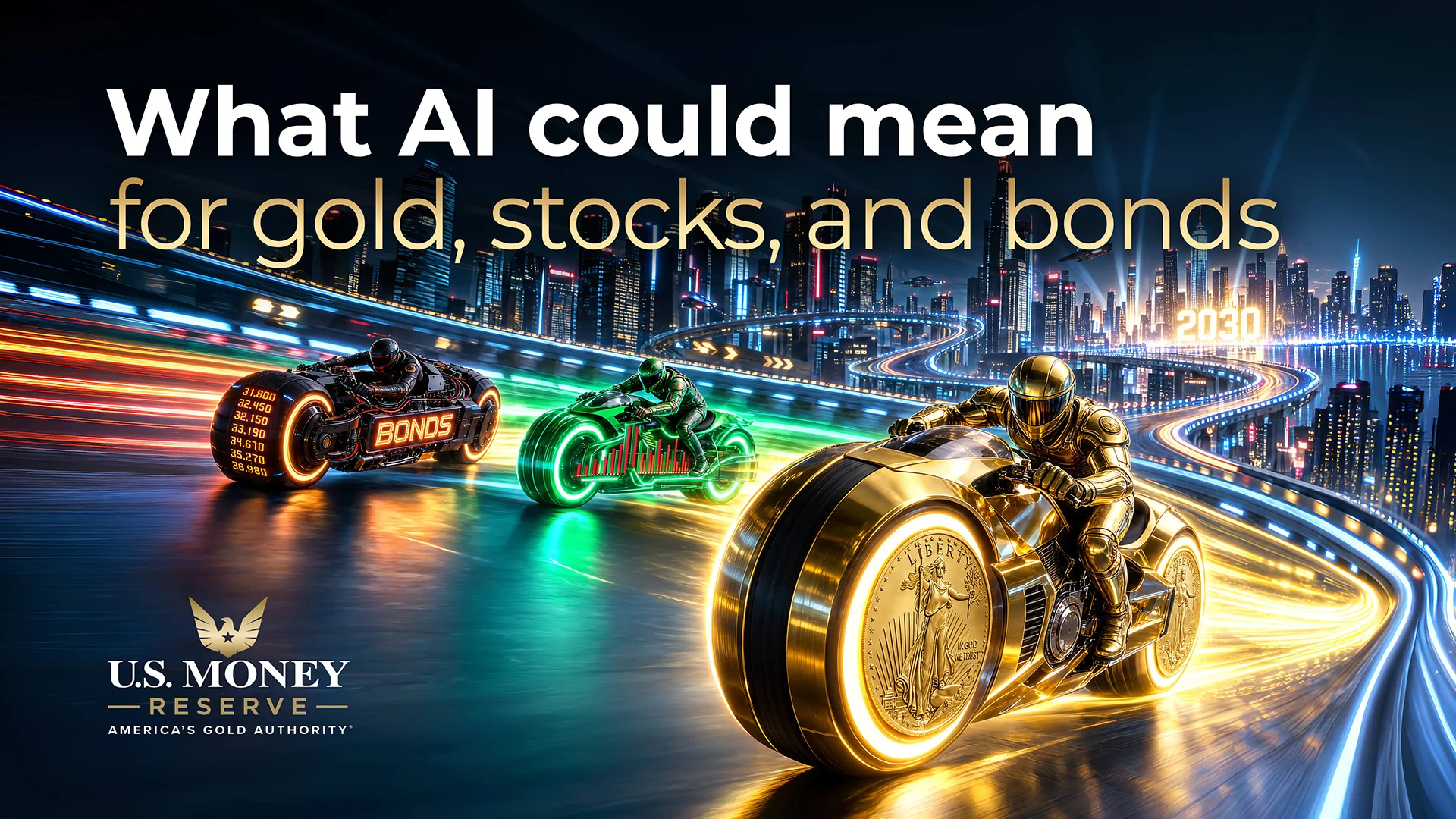
Under this scenario, U.S. AI companies become profitable and more competitive after a painful transition. Diehl’s model suggests gold, stocks, and bonds could all finish the period higher, with gold showing the strongest performance.
That does not mean a smooth climb. Diehl expects losses along the way, potentially including an initial decline in gold as people sell assets to meet immediate cash needs.
His less optimistic scenario centers on competition.
“Lower-cost Chinese AI models could become capable enough to meet many business and consumer needs, putting pressure on the revenues and profitability of American companies,” Diehl says.
In that scenario, Diehl sees the potential for a much larger stock market decline and a stronger rise in gold.
These are scenarios rather than certain outcomes. Their purpose is to explore how different developments in one influential industry could affect the broader financial landscape.
Watch the Podcast U.S. Money Reserve’s experts discuss the forces shaping the economy and what they could mean for your savings.How much of your portfolio depends on AI?
You do not have to own individual AI stocks to have exposure to the industry.
“People holding S&P 500 funds may have more money connected to the same technology companies—and the same expectations for AI growth—than they realize,” says Diehl. “They think they are diversified, but they are not.”
The underlying question deserves attention: How much of your savings depends on a relatively small group of companies continuing to perform well?
Owning several funds does not necessarily answer that question. If those funds hold many of the same companies, their performance may depend on similar market forces.
For someone approaching retirement, reviewing those overlapping holdings can help reveal where exposure is concentrated and whether assets beyond stocks and bonds deserve consideration.
Why AI’s costs matter
Diehl identifies the cost of developing AI as a central challenge.
“Companies must generate enough revenue to support spending on infrastructure, energy, and financing,” he says. “A useful technology does not automatically produce a profitable business, particularly when competitors offer similar capabilities at lower prices.”
Diehl believes the scale of those commitments could make the road to profitability longer and more difficult than some people expect.
He also cautions against assuming that a rising market means the risks have passed. Enthusiasm can continue even as financial pressures build, making the timing of a downturn difficult to anticipate.
His emphasis is on preparation.
“A balanced portfolio is crucial,” Diehl says. “Plan for the worst.”
Inflation and debt complicate the outlook.
AI is only one part of Diehl’s outlook through 2030. He also points to inflation, corporate and government debt, and geopolitical tensions as sources of uncertainty.
Interest rates connect several of those concerns. Higher borrowing costs can put pressure on companies financing large projects, while persistent inflation creates challenges for households and policymakers.
Diehl places particular emphasis on inflation expectations—what consumers believe will happen to prices in the future—as a risk he believes deserves close attention.
He also warns that the economic effects of conflict can outlast the fighting itself. Energy disruptions, defense spending, and additional borrowing can create pressures that take years to resolve.
An election may change leadership or policy priorities, but it cannot immediately settle all of those challenges.
Related Article What the Fed’s rate hike could mean for inflation, markets, and goldPlanning for more than one outcome
Diehl’s two scenarios lead to different outcomes for stocks, but both give gold a meaningful role.
His analysis considers gold’s potential to help protect savings during periods of uncertainty and help support growth over time. That does not mean gold will rise in every downturn or outperform other assets in every period.
It does offer a reason to look beyond a single forecast when reviewing your retirement plans.
What do you own? Where is your exposure concentrated? How might your assets respond if the next four years unfold differently than you expect?
You do not have to predict which AI companies will succeed to begin asking those questions.
To explore how physical gold may help you hedge against economic uncertainty, call U.S. Money Reserve at (866) 646-8465.