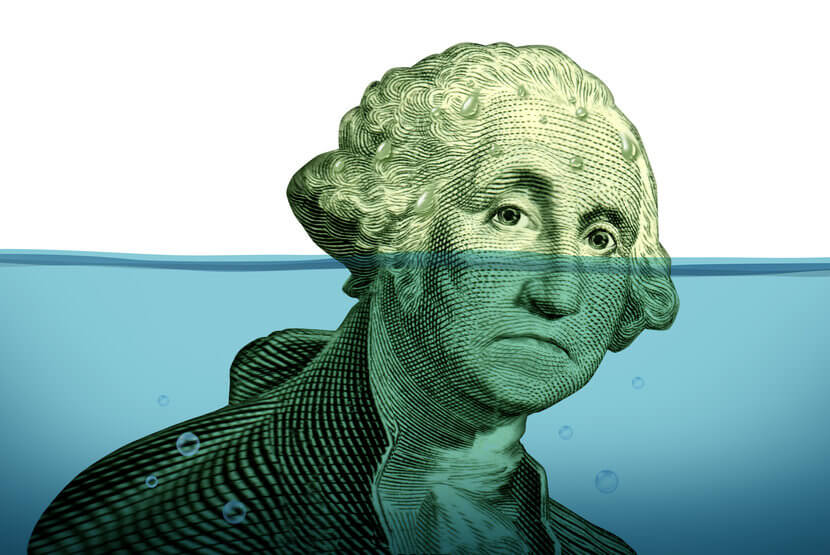

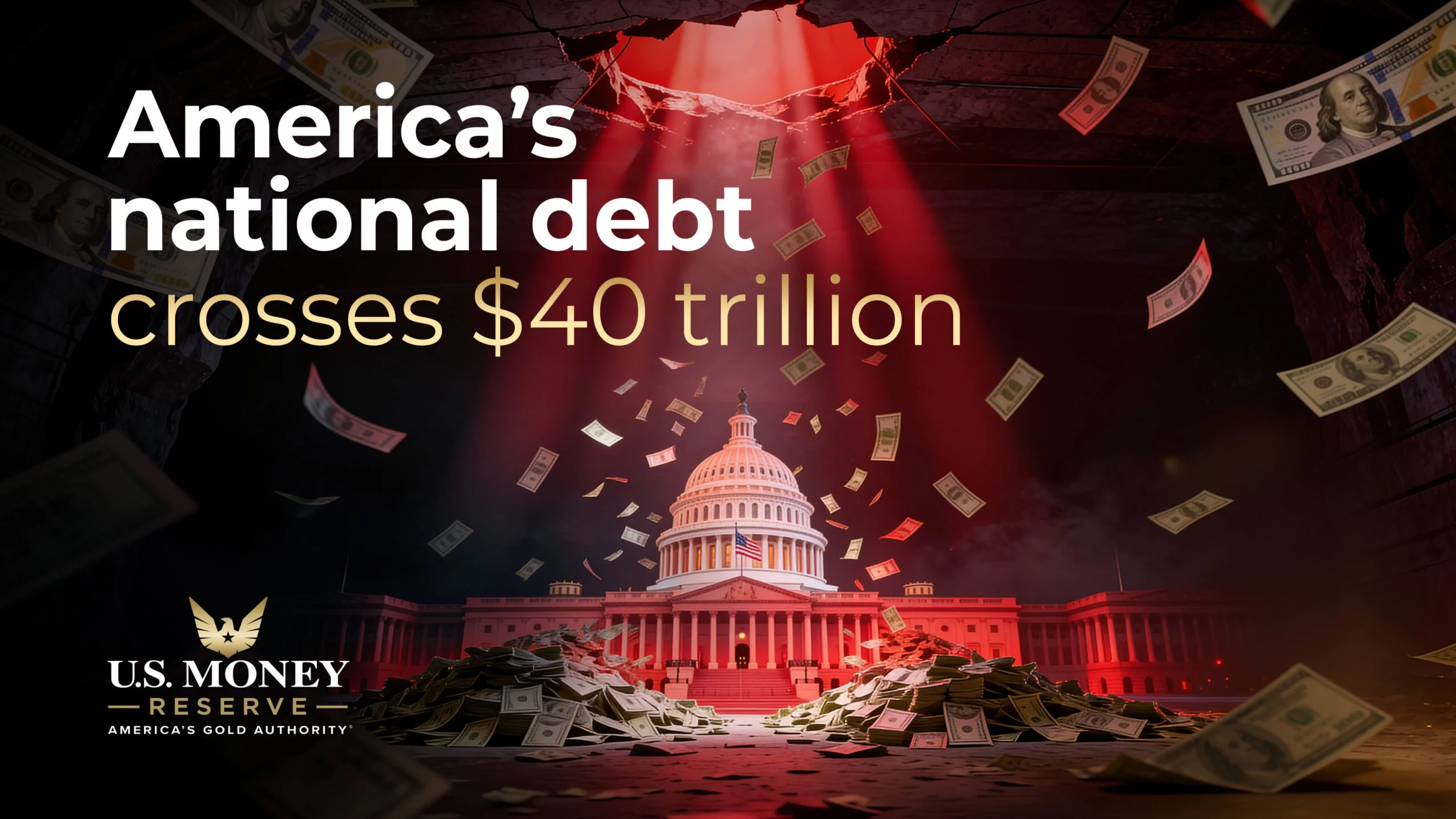
America’s national debt has topped $40 trillion, bringing renewed attention to a growing expense that delivers no new services or benefits: the interest Washington pays on its borrowing.
For Americans building retirement savings, the concern extends beyond the size of the federal balance sheet. Rising debt costs could put pressure on government finances, confidence in the dollar, and the purchasing power of dollar-based savings.
That is the warning from Edmund C. Moy, 38th Director of the U.S. Mint and Senior IRA Strategist for U.S. Money Reserve. In a recent discussion with Mike Barnes on America’s Gold Authority® Podcast, Moy explains why the debt’s trajectory matters—and why he believes gold deserves a place in the retirement conversation.
“It doesn’t amaze me,” Moy says of the milestone. “But it is a staggering number.”
Watch the Podcast Deep in the Red: America’s National Debt Crosses $40 TrillionImagine a $400,000 credit card balance on a $65,000 income.
Trillions of dollars can be difficult to connect to daily life. Moy puts the borrowing problem in household terms.
Imagine earning $65,000 a year while spending $85,000. Covering that gap requires borrowing another $20,000 annually. Meanwhile, the accumulated credit card balance has reached $400,000, and interest alone costs $10,000 a year.
That is the situation Moy uses to illustrate the strain on federal finances. The household keeps borrowing to cover its expenses, even as past borrowing consumes a substantial portion of its income.
The government has financing options households do not, including the advantage of issuing the currency used widely in international trade. But the analogy makes the underlying challenge clear: Paying interest does not erase the balance, and continued borrowing adds to the burden.
Related Article Debt, Inflation, and Fed Doubts Are Fueling Gold’s RiseThe interest bill can grow even if the debt does not.
The next challenge is what happens when older debt comes due.
Moy explains that some outstanding federal debt carries the low rates available when it was issued. When those obligations mature, replacing them with new debt at higher rates increases the cost of borrowing.
Using rounded figures, he describes the potential effect on a $40 trillion balance. An average annual interest rate of 2.5% produces $1 trillion in interest costs. If that average rate rises to 5%, the annual bill reaches $2 trillion—even if the debt itself has not grown.
The calculation illustrates the risk of refinancing at higher rates; it is not a fixed timetable for when federal interest costs will double.
For Washington, the consequence is less flexibility. More money goes toward servicing past borrowing rather than supporting current priorities. And unless revenue or spending changes, borrowing to cover those costs can deepen the problem.
Retirement programs enter the discussion.
Moy warns that rising interest expenses could crowd out room for other federal commitments, including Medicare and additional funding for Social Security.
His concern is not that reaching a particular debt number automatically cuts benefits. It is that an expanding interest bill makes competing demands on the budget harder to meet.
For people preparing to retire, that creates another reason to consider the financial conditions their savings may need to withstand. Retirement planning involves more than reaching a target balance. It also means thinking about future expenses, sources of income, and the purchasing power of the dollars accumulated along the way.
The national debt may feel distant from those decisions. Its financing costs are one way the connection becomes more immediate.
Related Article Portfolio risk after 60: A guide to stability in retirementCould mounting debt weaken the dollar?
The dollar’s international role gives the United States a significant advantage, Moy says. Countries and businesses need dollars to conduct trade, helping sustain demand for the currency and U.S. debt.
Still, he cautions that lenders can demand more compensation if they become less comfortable with the country’s fiscal direction. Higher borrowing costs, in turn, can intensify the pressure on government finances.
Moy sees a related risk to the dollar: As the debt and interest burden grow, creditors may question the country’s ability to meet its obligations without further financial strain.
A weaker dollar can support gold’s dollar-denominated price, although other forces also influence the metal. That relationship is central to Moy’s argument for holding some gold alongside other retirement assets.
For savers, his message is to consider not only how many dollars they have, but how exposed their savings are to a decline in those dollars’ purchasing power.
Related Article The Fed is divided on inflation. Here’s why that matters for gold.Diversification beyond the traditional 60/40 portfolio
Many people think of diversification as holding cash, stocks across different industries, and several types of bonds. Moy argues that this approach can leave an important category unexplored: alternative assets.
Gold has historically responded differently to economic conditions than stocks and bonds have, giving savers another way to spread their exposure. It does not move in the opposite direction every time other assets decline, but its different price drivers can contribute to diversification.
Many experts now recommend a 60/20/20 portfolio—60% stocks, 20% bonds, and 20% gold—as one alternative to the 60/40 mix. This approach can help diversify portfolios, manage risk, and provide resilience through changing market conditions. The appropriate mix depends on a person’s goals and circumstances.
Moy’s case for taking the long view
Moy distinguishes long-term gold ownership from speculation on daily price movements. His focus is people preparing for retirement and thinking in years rather than trading sessions.
“If you look at any 10-year period of gold prices, it is almost impossible to find a 10-year period where gold didn’t at least hold its value,” he says.
Moy also points to his own experience: Gold was around $1,500 an ounce when he opened his gold IRA with U.S. Money Reserve, compared with almost $4,500 at the time of this podcast.
His broader argument is that gold should be considered in the context of a long-term retirement strategy, particularly by people concerned about the dollar and the direction of federal finances.
Related Article Pros and Cons of Precious Metals IRAsWhat does your retirement strategy account for?
A $40 trillion national debt does not tell Americans exactly what will happen next. It does raise questions about the cost of borrowing, the choices facing Washington, and the resilience of personal savings.
For Moy, those questions reinforce the case for looking beyond a portfolio made up solely of stocks, bonds, and cash. Physical gold offers another asset to consider as part of a strategy built around long-term goals.
To learn more about physical precious metals and gold IRA options, speak with a U.S. Money Reserve Account Executive. Our team can answer your questions and help you explore how gold could fit into your retirement strategy.