Episode 76
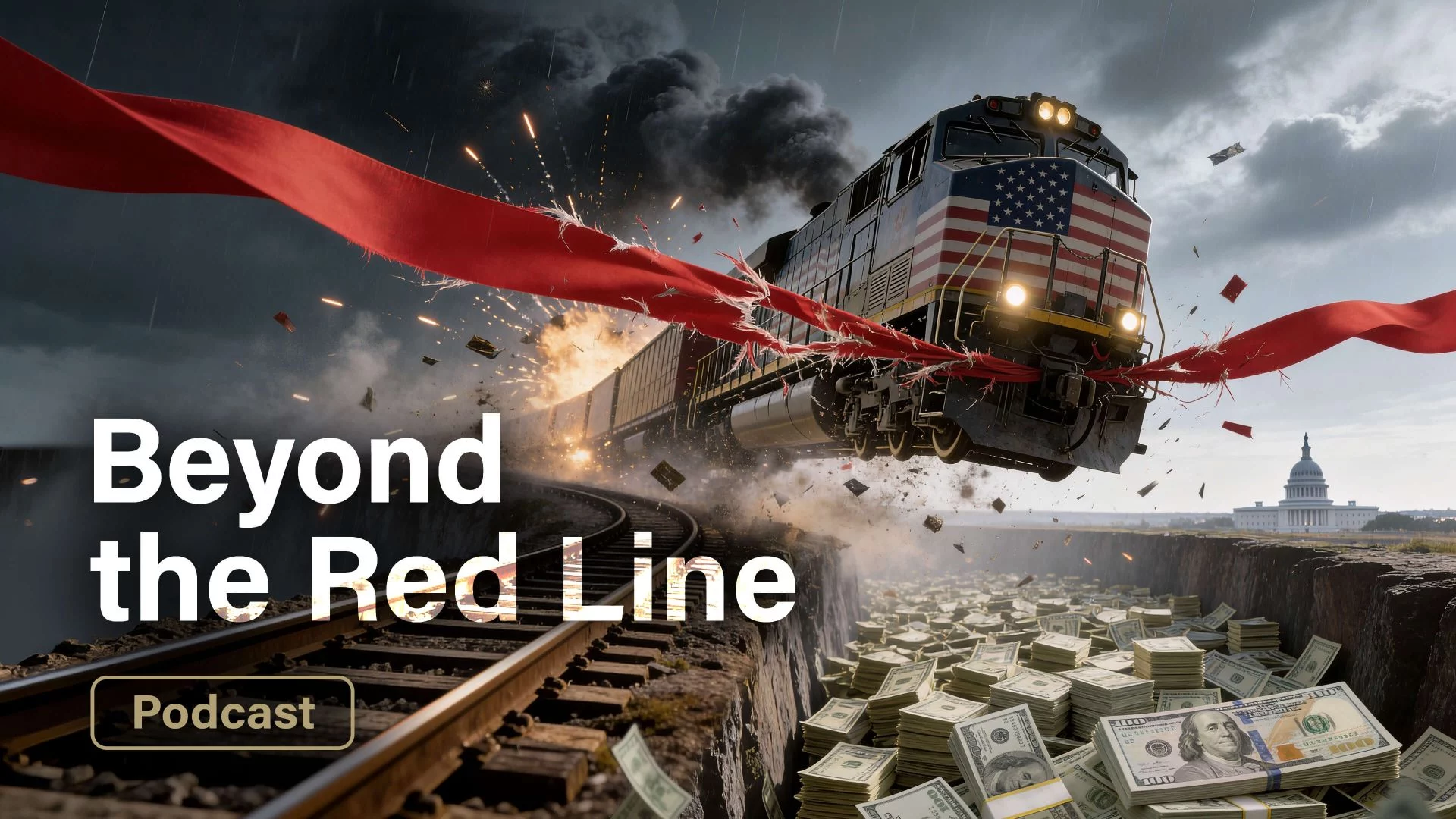
Deep in the Red: America’s National Debt Crosses $40 Trillion
On this episode of America’s Gold Authority® Podcast, host Mike Barnes is joined by Edmund C. Moy, 38th Director of the United States Mint and Senior IRA Strategist for U.S. Money Reserve, to examine America’s $40 trillion national debt and what its continued growth could mean for the economy, the U.S. dollar, and Americans preparing for retirement.
Episode notes
On this episode of America’s Gold Authority® Podcast, host Mike Barnes is joined by Edmund C. Moy, 38th Director of the United States Mint and Senior IRA Strategist for U.S. Money Reserve, to examine America’s $40 trillion national debt and what its continued growth could mean for the economy, the U.S. dollar, and Americans preparing for retirement.
Moy puts the scale of the debt into perspective by comparing the federal government to a household that consistently spends more than it earns and relies on borrowing to cover the difference. He explains how rising interest costs can consume a growing share of the federal budget, potentially leaving less room for programs such as Social Security, Medicare, education, and other priorities.
The conversation also explores how higher borrowing costs could make the problem more difficult. As older government debt issued at lower interest rates comes due, the Treasury may need to replace it with new debt carrying higher rates. Moy explains how that process could push annual federal interest costs significantly higher even if the total national debt remained unchanged.
Barnes and Moy then turn to the U.S. dollar. They discuss how concerns over federal debt and interest payments can affect confidence in the dollar and why a weaker dollar can support higher gold prices. For Americans approaching retirement, Moy argues that this creates another reason to think carefully about diversification beyond traditional holdings such as cash, stocks, and bonds.
The episode also examines the role physical gold can play in a diversified retirement strategy. Drawing on his experience as Director of the U.S. Mint and his own use of a gold IRA, Moy discusses why some Americans turn to gold for long-term diversification and to help offset risks tied to currency weakness and broader financial uncertainty.
U.S. Money Reserve is widely known as one of America’s largest private distributors of government-minted gold, silver, platinum, and palladium. Discover why U.S. Money Reserve is the top choice for establishing a precious metals IRA—an option guided by the unmatched institutional insight of two former U.S. Mint Directors. Acknowledged as a trusted industry leader, U.S. Money Reserve has served more than one million clients and facilitated over $4.4 billion in transactions.
Read the full transcript
MIKE BARNES 0:10
Welcome to America’s Gold Authority Podcast. My name is Mike Barnes. Today we’re talking about the national debt. $40 trillion. That’s a four and thirteen zeros. It is a lot, and it’s something to talk about with Ed Moy, 38th Director of the United States Mint, Senior IRA strategist for U.S. Money Reserve. And Ed, does this number $40 trillion? Does that amaze you?
ED MOY 0:34
It doesn’t amaze me because uh anyone who’s been tracking this has seen the uh trajectory, and it’s not pretty. Uh, but it is a staggering number. And it uh the the number is so big that the talk in Washington this past week, uh the um the national debt and the interests with it have been really big topics.
MIKE BARNES 1:01
It’s just amazing how large it is. I know every country basically, other than maybe Liechtenstein, has a national debt, but the fact that it’s grown so so much just in the last 10 years, it’s just out of control, isn’t it?
ED MOY 1:13
Every country, as you said, uh has growing debt. Uh, the United States has generally been less of a percentage of the uh gross national product of a country than most other countries. But I liken this to your laundry basket. There’s a bunch of dirty shirts in there. The United States happens to be the least dirty shirt.
MIKE BARNES 1:37
That’s a good analogy. I like that. You know, it’s been around forever. National debt. I remember back in 1980 when Jimmy Carter and Ronald Reagan were fighting it out for the presidency, and national debt was a big reason why. And back then, $910 billion. I thought that was out of control then, and that’s nothing compared to $40 trillion.
ED MOY 1:58
Yep, yeah, it’s uh it’s 40x uh compared to that period of time. And you know, I want to um help uh educate Americans, uh, which I do uh in all walks of my life, on what that really uh feels like, uh, so that people have a more personal understanding of what the national debt is, because most people go, okay, so what? It doesn’t matter to me. Well, if you were to think of the national debt as credit card debt and the US government as a household, you know, just think about this. The household earns $65,000 a year, but it spends $85,000 a year. It has to borrow $20,000 just to pay all its bills. And uh that $20,000 is coming from a credit card that you have to pay interest on. And by law, you have to pay the interest uh uh or the whole thing collapses. So when you think about that, um America’s accumulated $400,000 worth of credit card debt on $65,000 of income each year. It’s staggering. The interest payments alone, if you use that analogy, if you make $65,000 a year, the interest payments alone are $10,000 a year. That’s just amazing.
MIKE BARNES 3:31
And I think that the thing that confuses me is that if I’m going for a loan and I say I have $100,000 in debt because I own, uh I owe $100,000 to my house, they’re like, oh, that’s that’s good. You’re doing a good job. If I say I have $100,000 in credit card debt, they say, ooh, Mr. Barnes, I don’t like that very much. Why does the U.S. government have this type of debt compared to the good type of debt?
ED MOY 3:55
So this is unsecured debt, right? Uh it’s not based on anything. And even if you would base it on all the gold in Fort Knox, uh, there’s only roughly a trillion dollars worth of gold in Fort Knox. It’s not enough to um to leverage uh uh for the debt. So the big difference here is that because the whole world uses US dollars in international trade, it gives the United States an basically an unfair advantage uh in money, in that everybody needs to have dollars. But there are some danger signs. Uh, the past few weeks, the United States, when it um asks for loans, basically we sell notes uh in exchange for the money. Um the note buyers have come back saying, eh, we really don’t like the way that your debt’s going and the interest payments. It’s not as safe as we think it was before. So we’re gonna charge you more interest on the money that we’re loaning to you, which has sent alarm bells through my old employer, which is the U.S. Department of Treasury.
MIKE BARNES 5:07
That’s just amazing. How do you think this affects people as they’re planning their retirement? Because this has to affect us some way.
ED MOY 5:15
Yes. So it affects uh in multiple ways. Uh, first of all, um as the interest payments grow on the national debt, uh that squeezes out things like uh Medicare payments and uh Social Security, uh access to additional funds for Social Security. So right now we have uh roughly a trillion dollars of interest on uh $40 trillion of national debt. So what is the interest rate? It’s 2.5%. 2.5% of uh is the average interest rate throughout all that debt. We have a lot of debt at 0 or 1%, and all the new debt that we’re uh getting is at 5%. The problem is some of that zero and one and two percent debt as it comes due, we can’t pay it back. So we have to borrow money at 5% to retire a loan at 0%. So eventually, even if the um national debt doesn’t change from 40 trillion, that 2.5% will go up to 5%. That means instead of $1 trillion of interest payments, that doesn’t go for benefits, it doesn’t go for income support, it doesn’t go for education, it just goes to paying down the debt. That $1 trillion becomes $2 trillion and becomes the second biggest item in the federal budget.
MIKE BARNES 6:48
That’s just amazing the numbers that you mentioned. I guess the only good thing is it’s not the 19 or 20 percent of credit card interest that a lot of people have to pay, but that interest adds up so much. And doesn’t that just weaken the US dollar?
ED MOY 7:02
Absolutely. So when you have uh that big of interest payments, uh the world begins to take a look at the dollar saying, how good is the United States going to be in paying at least the interest payments, if not the principal, back to us? And uh from that perspective, there usually comes a weakening of the dollar. And when the dollar gets weaker, uh that benefits gold prices because gold is priced in dollars, so it takes more dollars to buy an ounce of gold. It’s especially important to those people uh that are looking at retirement eventually, is that uh uh the further down we go uh on this path, um the higher the risk that uh the dollar value will go down and gold prices will go up. And so if you’re really interested in protecting yourself, uh when you get to retirement age, you’re gonna want to diversify your portfolio uh to include some gold.
MIKE BARNES 8:08
This is where that 6040 split should become 60 2020 to make sure you have gold in your portfolio. Because if you don’t, that weak dollar is just gonna hurt you when you turn 65.
ED MOY 8:20
Most people make the mistake of thinking that diversity means having some retirement uh money in cash, putting some in the stock market, and putting some maybe in bonds. Uh then when you really push them on diversity, they go, okay, well, I’m gonna have diversified stock portfolio in different industry sectors, and I’m gonna look at uh bonds, not only corporate bonds, but uh uh municipal bonds, tax uh taxable bonds, and tax-free bonds. And that’s where they stop. The problem with that uh philosophy is that all those relationships between cash, stock, and bonds are pretty predictable. What you need is something that reacts in the opposite direction, that if all three of those start going in bad directions, there’s something else that goes in a good direction. That’s what’s called an alternative asset. And gold is one of the most popular, most accessible alternative assets available.
MIKE BARNES 9:23
And it’s something for those of us who are getting closer and closer to retirement age, we need to look at those alternative assets as not only an option, but something to really lean on, correct?
ED MOY 9:34
Absolutely. And so, you know, um when I was the min director uh from 2006 to 2011, when I first started, I took a look at uh gold IRAs because Congress had uh passed a law making those legal. And uh what I found was gold IRAs um were just becoming more popular because people were beginning to understand the need for diversification. And so one of the first things I did after I left the mint uh was to uh invest in a gold IRA myself. And my gold IRA today is with U.S. Money Reserve.
MIKE BARNES 10:16
Very smart move. And look at what gold has done just over the last couple of weeks. I think since August the 3rd, it’s up about 16, 17 percent. Yeah, gold has continued to go up, even though it’s had some downtimes lately, but gold continues to go up, and the forecasters say it’s going to go up even more.
ED MOY 10:32
Especially for people considering retirement. And I’m not talking about the um speculators that uh day trade on gold. I’m talking about people who are interested in the long term. And if you look at any 10-year period of gold prices, it is almost impossible to find a 10-year period where gold didn’t at least hold its value. And almost all the time in a 10-year period, gold has increased in value. When I started my gold IRA, it uh gold was around uh $1,500 an ounce. It’s almost $4,500 today.
MIKE BARNES 11:09
Amazing. Long term, things look good for gold, long term for the country with $40 trillion of debt. Not so sure. But Ed Moy, you’ve explained so many things. I really appreciate you joining me today. Really delighted to be with you, Mike. I think something that we need to understand is that that $40 trillion, it will affect us at some point, especially if it causes the dollar to get weaker. And at that point, you need to turn to gold. That’s all the time we have for today’s episode. On behalf of all of us here in the U.S. Money Reserve Studios, thank you for tuning in. If you have any questions or you want to learn more about today’s episode, you can call the number in our episode description and speak with one of our friendly account executives. They’re going to be more than happy to answer any questions you may have about precious metals and the strategic role they can play in achieving a secure and comfortable financial future. I’m Mike Barnes. We will see you next time on America’s Gold Authority Podcast.

Ready to protect your savings? Get your free guide today.
Get your free guideKeep listening
Related episodes
- Episode 62Beyond the Red Line: Bond Market Crisis and America’s Debt
On this episode of America’s Gold Authority® Podcast, host Mike Barnes is joined by Philip N. Diehl, President of U.S. Money Reserve and former Director of the U.S. Mint, and Brad Chastain, U.S. Money Reserve’s Managing Director and Global Head of Research, to examine two growing threats facing the global economy: America’s expanding debt burden and rising instability in the bond market.
Listen now - Episode 35How We Got Here: The 50-Year Mortgage and the Cost-of-Living Spiral
On this episode of America’s Gold Authority® Podcast, host Mike Barnes is joined by Philip N. Diehl, President of U.S. Money Reserve and former Director of the U.S. Mint, and Brad Chastain, U.S. Money Reserve’s Director of Education. Together, they examine the growing conversation around 50-year mortgages and what this unusual proposal says about affordability in today’s economy.
Listen now - Episode 75Off the Chain: What Happens When Inflation Expectations Break Loose
On this episode of America’s Gold Authority® Podcast, host Mike Barnes is joined by Philip N. Diehl, President of U.S. Money Reserve and former Director of the U.S. Mint, and Brad Chastain, U.S. Money Reserve’s Managing Director and Global Head of Research, to examine why inflation expectations matter and what can happen when higher prices become entrenched in the economy.
Listen now