

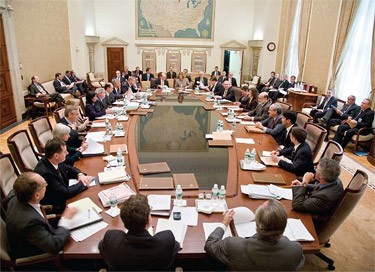
Today, the Federal Reserve's Open Market Committee (FOMC) started a two-day meeting during which it decides whether to begin tapering the $85 billion a month bond buying program known as QE3.
QE3 is the third installment of the Fed's unprecedented efforts to reduce long-term interest rates. The Fed's traditional monetary policies address short-term interest rates; however, in 2010, when the economy continued to tank after the Fed lowered short-term rates to near zero, it turned to QE to further boost the economy.
QE has worked to a degree, not only in the U.S. but also elsewhere, especially in emerging markets. But two big questions cast shadows over the Fed's policy: what are the unintended effects of QE and what will be the consequences of unwinding the $3 trillion (and counting) in assets the Fed has added to its books under QE?
What's at stake
These questions are on the table at the FOMC meeting along with concerns that reducing QE3 will undermine our fragile recovery and contribute to currency crises gaining steam in some of the emerging markets. In June, when Fed chairman Bernanke merely discussed the possibility the Fed would start to taper this fall, interest rates jumped. This overreaction reflects markets' hypersensitivity to the Fed's monetary policy decisions as well as a misunderstanding of those admittedly complex policies.
I think the greater risk is on the side of tapering too soon, but then I'm just another schmuck with an opinion. What's the broad assessment of what the FOMC will do?
The short answer is, the FOMC will decide to begin tapering now, reducing bond purchase by $10 billion to $20 billion a month. Markets are assuming as much and prices already reflect this expectation. If the FOMC decides to take a bigger bite out of QE3, which seems unlikely, we'll see a sharp correction.
A dwindling minority of analysts think the FOMC will delay a decision until December, after more economic data arrive.
So much for the conventional wisdom
So, where's the smart money on the question? The Fed will take small steps down this path due not only to risks that tapering poses to the recovery but also because, in the months ahead, there will be significant turnover in the FOMC's membership. People are policy and the Fed will be cautious about committing to a course of action only to reverse itself when new members with different assessments come aboard.
So, the Fed will make a modest reduction in QE3 now, to $75 billion a month, and Bernanke will say further reductions will be made in the future, if warranted, based on data to come. He'll also state that if new weakness in the economy emerges, the Fed could intervene by increasing its bond purchases.
Note that the upshot of beginning to taper QE3 is that the Fed will continue to add to its $3 trillion in QE assets, probably in the neighborhood of another half a trillion dollars before all is said and done. At some point, the Fed will face the much more delicate task of disposing of those $3.5 trillion in bonds without sending interest rates skyward and crashing equity markets.
This will be an environment in which gold thrives.