
Exchange-traded funds (ETFs) have made it easy to gain exposure to gold’s price. But ETFs—often referred to as a form of “paper gold”—represent ownership of a trust, not ownership of physical gold. And while they have become popular with some sophisticated traders, one group has stayed away: the world’s central banks.
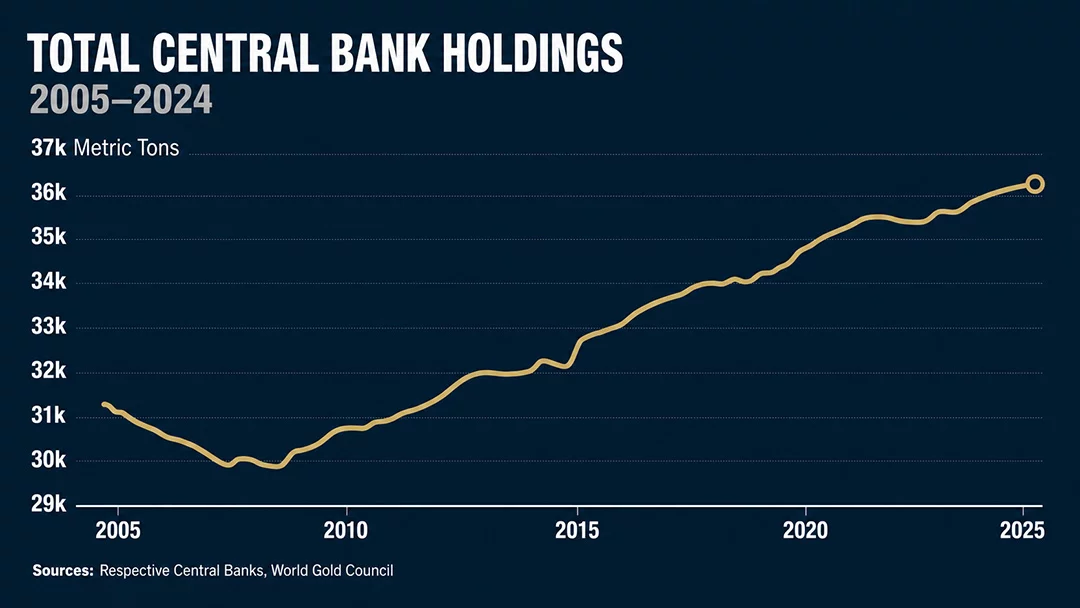
In fact, central banks continue to add physical gold to their national reserves at record levels. They added more than 1,000 metric tons of gold for three consecutive years before remaining well above historical averages in 2025, the World Gold Council reports.
According to Philip N. Diehl, 35th Director of the U.S. Mint and President of U.S. Money Reserve, that trend raises an important question:
“Central banks hold a fifth of the gold ever mined in all of human history. If the institutions that are responsible for protecting the wealth of nations choose physical gold, why?”
The answer comes down to understanding the different roles ETFs and physical gold are designed to serve. ETFs were built for short-term trading, not long-term ownership.
Watch the Podcast Physical Gold vs. ETFs: Why Central Banks Hold the Real ThingETFs were built for trading, not long-term ownership.
Gold ETFs allow buyers to track the price of gold without buying and storing. They’re easy to buy and sell through brokerage accounts.
But Diehl says convenience shouldn’t be confused with ownership.
“ETFs were really tailor-made for people trading gold over short periods,” he explains. “When you purchase an ETF, you don’t actually own gold. You own a contract that provides exposure to the price of gold.”
Brad Chastain, Global Head of Research at U.S. Money Reserve, agrees.
“If you’re looking to trade gold over the next week or month, ETFs can make sense,” Chastain says. “But for long-term wealth preservation, physical gold offers advantages that paper products simply can’t.”
That distinction helps explain why hedge funds and short-term traders frequently use ETFs while central banks overwhelmingly hold physical gold.
Why do central banks insist on physical gold?
One of the biggest reasons is counterparty risk, Chastain says.
When a central bank owns physical gold stored in its own vaults, it owns the asset outright—no intermediary stands between the owner and the gold. With an ETF, by contrast, you own shares of a trust that holds the gold, not the gold itself.
“There are multiple parties involved in that structure,” Chastain says. “Physical gold eliminates that layer of counterparty risk.”
That distinction carries extra weight in moments of geopolitical stress. Paper-based gold products can be exposed to sanctions or disruptions affecting financial intermediaries in ways physical reserves, held within a country’s own borders, are not.
It’s a consideration that has helped fuel one of the strongest periods of central bank gold buying in modern history.
According to Diehl, central banks have gone from being net sellers of gold two decades ago to consistent buyers, averaging roughly 1,000 metric tons per year. Diehl says that sustained buying has become an important force in the gold market, helping support prices even during recent pullbacks.
The costs many ETF buyers never notice
The discussion isn’t only about ownership.
Chastain points out that gold ETFs also carry ongoing expense ratios that gradually reduce returns over time.
Unlike a one-time transaction cost, those fees continue year after year and compound as an account grows.
“You don’t see yourself paying those fees,” Chastain says. “The fees come directly from the assets of the fund and directly reduce performance. Over long holding periods, those differences can become substantial.”
Physical gold held in an IRA carries its own custodial fee, but it’s a flat cost rather than a percentage. According to Chastain, once an account holds around $56,000 in gold, a typical ETF’s expense ratio costs the account owner more per year than U.S. Money Reserve’s negotiated custodial fee. And the gap only widens as the account grows, since the ETF fee scales up with it while the flat fee doesn’t.
Tax implications of ETFs
Chastain says many buyers overlook another important consideration outside retirement accounts.
Because gold may be sold within an ETF to cover operating expenses, ETF holders may owe taxes each year, even if they never sell their ETF shares.
Diehl says those tax implications are often overlooked.
“The tax treatment is a substantial disadvantage that many people—including financial advisors—may not fully understand,” Diehl says.
Ownership versus exposure
Chastain compares a gold ETF to owning shares of a publicly traded company.
“If you own Apple stock, you’re technically an owner of Apple,” he says. “But that doesn’t mean you can walk into an Apple Store and take an iPhone off the shelf. Gold ETFs work similarly. You own a share of a trust that owns gold—you don’t own the gold itself.”
For those seeking long-term financial security rather than short-term trading, that distinction is significant.
What can Americans learn from the world’s central banks?
If you want to trade price movements, you may find ETFs convenient.
But for those seeking long-term ownership, portfolio diversification, wealth preservation, wealth appreciation, and peace of mind, you may prefer the same approach increasingly favored by central banks: owning physical gold.
“You own the gold,” Diehl says. “You don’t own a paper contract.”