Episode 56
Stacked for Stability: Where Gold Fits in Modern Banking
On this episode of America’s Gold Authority® Podcast, host Mike Barnes is joined by Philip N. Diehl, President of U.S. Money Reserve and former Director of the U.S. Mint, and Brad Chastain, U.S. Money Reserve’s Managing Director and Global Head of Research, to examine how evolving banking regulations could reshape gold’s role in the global financial system.
Episode notes
On this episode of America’s Gold Authority® Podcast, host Mike Barnes is joined by Philip N. Diehl, President of U.S. Money Reserve and former Director of the U.S. Mint, and Brad Chastain, U.S. Money Reserve’s Managing Director and Global Head of Research, to examine how evolving banking regulations could reshape gold’s role in the global financial system.
They break down the concept of “high-quality liquid assets”—a classification developed after the 2008 financial crisis to ensure banks can meet short-term liquidity demands—and why gold has historically been excluded from that category. The discussion explores the growing push by organizations like the World Gold Council and London Bullion Market Association to reclassify gold alongside cash and government bonds, and what that reclassification could mean for institutional gold demand.
Diehl and Chastain also clarify widespread confusion around Basel regulations, including the difference between capital rules and liquidity rules, and why recent reports about gold’s classification have been misunderstood. They explain how a formal shift to include gold as a high-quality liquid asset could reduce costs for banks, encourage broader adoption, and introduce a new source of demand into an already constrained market.
U.S. Money Reserve is widely known as one of the country’s largest private dealers of government-minted gold, silver, platinum, and palladium. It’s the only precious metals firm guided by two former U.S. Mint Directors, giving the company unrivaled institutional insight. Having served more than one million customers and processed over $4.4 billion in transactions, U.S. Money Reserve is widely trusted for helping Americans safeguard their financial future.
Read the full transcript
MIKE BARNES 0:10
Welcome to America’s Gold Authority Podcast. My name is Mike Barnes. High quality liquid assets. It’s usually been cash and bonds through the years, but some people want to put gold in the mix. Let’s talk to our experts about that. Brad Chastain and Philip Diehl joined me now. And Brad, I want to start with you today. In your role at U.S. Money Reserve, you do a lot of educating. So tell us about high-quality liquid assets and what it really means.
BRAD CHASTAIN 0:35
Yeah, high-quality liquid assets are a category that fall uh that are created by certain regulations to meet new banking standards, essentially. Ever since the global financial crisis in 2008, we’ve seen a lot of different regulations come into play to try to fix a variety of things. And one of them is what we call a liquidity coverage ratio. And that’s just simply a way of saying that banks need to be able to have enough high-quality liquid assets that have the liquidity requirements to be able to quickly raise cash to meet, let’s say, 30 days of outflowing funds as people start sort of scrambling for crap cash during those times of stress. And so when they hold a certain ratio, they they qualify as meeting the liquidity coverage ratio, but not all assets fall in that category. And so one that has been notably absent that many people have advocated for a long time is gold. Right now it’s things like cash and bank reserves and treasuries. And so by if they were to re-categorize gold, and there’s a big push that it should be, World Gold Council has done a lot of work, and LBMA has done a lot of work on it as well, academic research to make sure that it meets the standards required. And uh ultimately they’re putting together a pretty strong case that gold, in fact, should be considered on par with other high-quality liquid assets like that to meet that. So, what that would ultimately do is make it so that holding gold helps regulate helps banks meet their regulatory obligations, encourages them, and in other cases makes gold less expensive for them to hold.
MIKE BARNES 2:24
That makes sense. Phil Diehl, as the 35th Director of the U.S. Men and president of U.S. Money Reserve, does it matter to us, the consumers, or does it just affect the banks what gold is categorized as?
PHILIP N. DIEHL 2:36
No, it it matters to us, but I have to first admit that before I got into the gold business as Director of the United States meant, I thought that high-quality liquid assets were like top-shelf single mold, scotch. And it wasn’t until later when I got into the business that I came to realize it’s something much more valuable than that. And having gold enter that uh that realm is important for gold holders and gold buyers because it creates a whole new level of demand, a whole new source of demand for gold. And of course, new sources of gold for uh demand for gold raise prices. And um and it also recognizes gold’s long-term role as uh providing uh protection to government assets, to individual assets, uh, and just people like us. So um it’s it’s a very important potential development.
MIKE BARNES 3:38
Brad, looking on the web, reading some articles, looking at some different websites, it seems like there’s a little bit of confusion about where gold stands. Some people say, oh, it’s a tier one asset, but it it’s kind of confusing in that respect, is it not?
BRAD CHASTAIN 3:51
It’s extraordinarily confusing. Um the the regulations that this is uh that this falls under are created by um the Basel Accords, uh specifically Basel III most recently. And I have spent a couple years reading and trying to learn, you know, all the ins and outs. And I think to fully really understand all of it, you really have that has to be your full-time job at a bank to make sure that you’re compliant with it, you know, day in and day out kind of thing. But I remember, you know, about the middle of last year, there was started being a lot of publicity, even Bloomberg and other respectable reporting places uh saying that, hey, gold has been reclassified as a tier one asset. And we didn’t report on it because it really didn’t align uh to what our understanding of the regulations were. But then subsequently, you know, a month or two months later, both World Gold Council and London uh LBA, LBMA came out and said, in fact, gold had not been reclassified, it that the reporting was incorrect, and they were confusing the capital rules with liquidity rules. Gold, allocated gold has always been considered a um a tier one uh or sorry, uh it’s always been considered tier one capital for capital rules, which means they don’t have to hold additional funding against it, it counts towards those requirements, but not the liquidity rules. And so a lot of reporting came out that it got changed and reclassified for liquidity, and that got a lot of attention, but um it’s been clear that it hasn’t. And if it does, and they’re pushing hard for it, that would ultimately be a nice boost for uh gold’s role in the banking system.
MIKE BARNES 5:40
I think we need a flow chart to figure all this out. It gets very confusing. Philip, the World Gold Council gets involved as well, and and Brad mentioned it earlier. Does that make it even more muddier, so to speak, as they’re trying to get different things done?
PHILIP N. DIEHL 5:54
Well, though it gets muddier the deeper you dive into the issue, like what Brad was talking about. This is very complicated. Uh I don’t make, I don’t follow it that closely. Thank thankfully Brad does. I follow other things. But these are the kinds of nuances and complications that have such a big impact on uh on gold prices, for example, and other asset prices, and that are set behind closed doors by people who have deep expertise and understand what the implications are. Uh, of course, one of the big concerns in the wake of the global uh financial crisis was the kinds of uh assets that would be required of banks to uh to stabilize them and to protect the entire global financial system. And these kinds of discussions have been rolling out ever since that period of time. So these complications are always going to be muddy. There are a lot of players involved, there’s lobbying involved, there are huge stakes for companies and for their management in terms of the profits that are generated from the banks. So, yes, this is confusing. There’s a big tug of war, and the details change all the time, and that’s why uh we have people like Brad who are willing to wrestle with these complications and then tell us uh what the implications are.
MIKE BARNES 7:30
Brad, let’s go back to you and talk about these implications. Again, talk about us, the consumers. If we’re thinking about diversifying and going into precious metals, specifically gold, or if we already have gold in our portfolio, how is this affecting us?
BRAD CHASTAIN 7:46
Right now, it at this particular moment it doesn’t a lot, right? We’ve talked ad nauseum about all of the other things that do that make gold a long-term store of wealth and the future prospects of gold. Um, so if if nothing changes here, the nice thing about this is there’s no downside risk. Right now, nothing has changed in this regard for uh a very, very long time. But if it does end up going through, and as gold continues to take a greater stay, uh greater place in the overall monetary system and financial system globally, as we kind of go through this deglobalization shift that we’ve talked about, uh it seems more likely that it will end up being approved and become one of those high-quality liquid asset uh classified tiers. That is just an extra boost for gold. So that’s the nice thing about this is that if it if it never comes to fruition, which I don’t think is likely, I think long term they’ll be able to get it done. There’s not really a negative consequence. It’s only positive for that and adds to all of the other positive benefits that gold have uh going forward.
MIKE BARNES 8:55
And Philip, we’ve talked so much about all these other things that are helping gold right now. This is just would just be another one that would help. So there’s nothing that keeps us from saying gold is the way to go right now.
PHILIP N. DIEHL 9:06
No, that’s right. And this is just another one of the big issues out there that uh are new developments, new to many of us, probably most of us, that had the potential to have a big impact on gold prices, demand for gold. Uh the there’s a whole nother discussion on stable coins and the role gold may play in backing stable coins and and what that may represent for uh gold prices and the opportunity for gold prices in the near future. Um so yeah, stay tuned here. We’re gonna talk about all those issues in the coming weeks.
MIKE BARNES 9:49
Lots of things to be excited about, and thank you so much for clearing up the confusion. High quality liquid assets, we now understand it. Thank you so much, Brad and Philip. Thank you, Mike. Thanks, Mike. That is all the time we have for today’s episode. On behalf of all of us here in the U.S. Money Reserve Studios, thank you for tuning in. If you have any questions or you want to learn more about today’s episode, you can call the number in our episode description and speak with one of the friendly account executives. They will be more than happy to answer any questions you may have about precious metals and the strategic role they can play in achieving a secure and comfortable financial future. I’m Mike Barnes. We will see you next time on America’s Gold Authority Podcast.

Ready to protect your savings? Get your free guide today.
Get your free guideKeep listening
Related episodes
- Episode 68Market Opportunity: Why Gold’s Long-Term Case Endures
On this episode of America’s Gold Authority® Podcast, host Mike Barnes is joined by Philip N. Diehl, President of U.S. Money Reserve and former Director of the U.S. Mint, and Brad Chastain, U.S. Money Reserve’s Managing Director and Global Head of Research, to examine gold’s recent correction and why they believe the long-term bull market remains intact.
Listen now - Episode 54Gold’s Path Forward: Interest Rates and the Bigger Picture
On this episode of America’s Gold Authority® Podcast, host Mike Barnes is joined by Philip N. Diehl, President of U.S. Money Reserve and former Director of the U.S. Mint, to examine how interest rate policy, inflation pressures, and global uncertainty are shaping gold’s outlook.
Listen now - Episode 62Through the Inflation Storm: Gold, Energy Markets, and the Fed
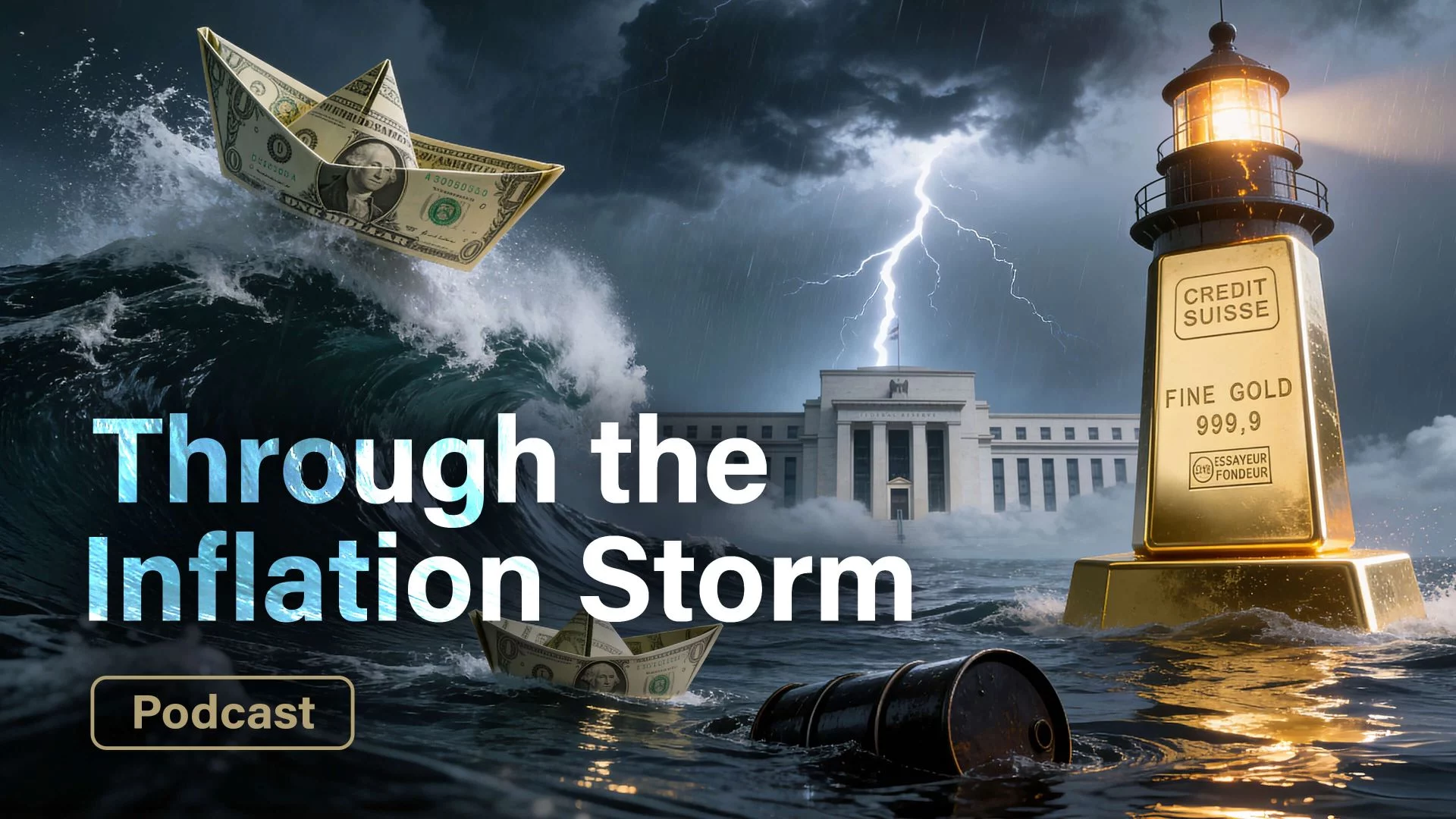
On this episode of America’s Gold Authority® Podcast, host Mike Barnes is joined by Philip N. Diehl and Brad Chastain to examine rising inflation, energy market disruption, and the Federal Reserve’s next move. They explain why higher oil and food costs could keep pressure on consumers—and why gold continues to play a growing role in long-term protection.
Listen now